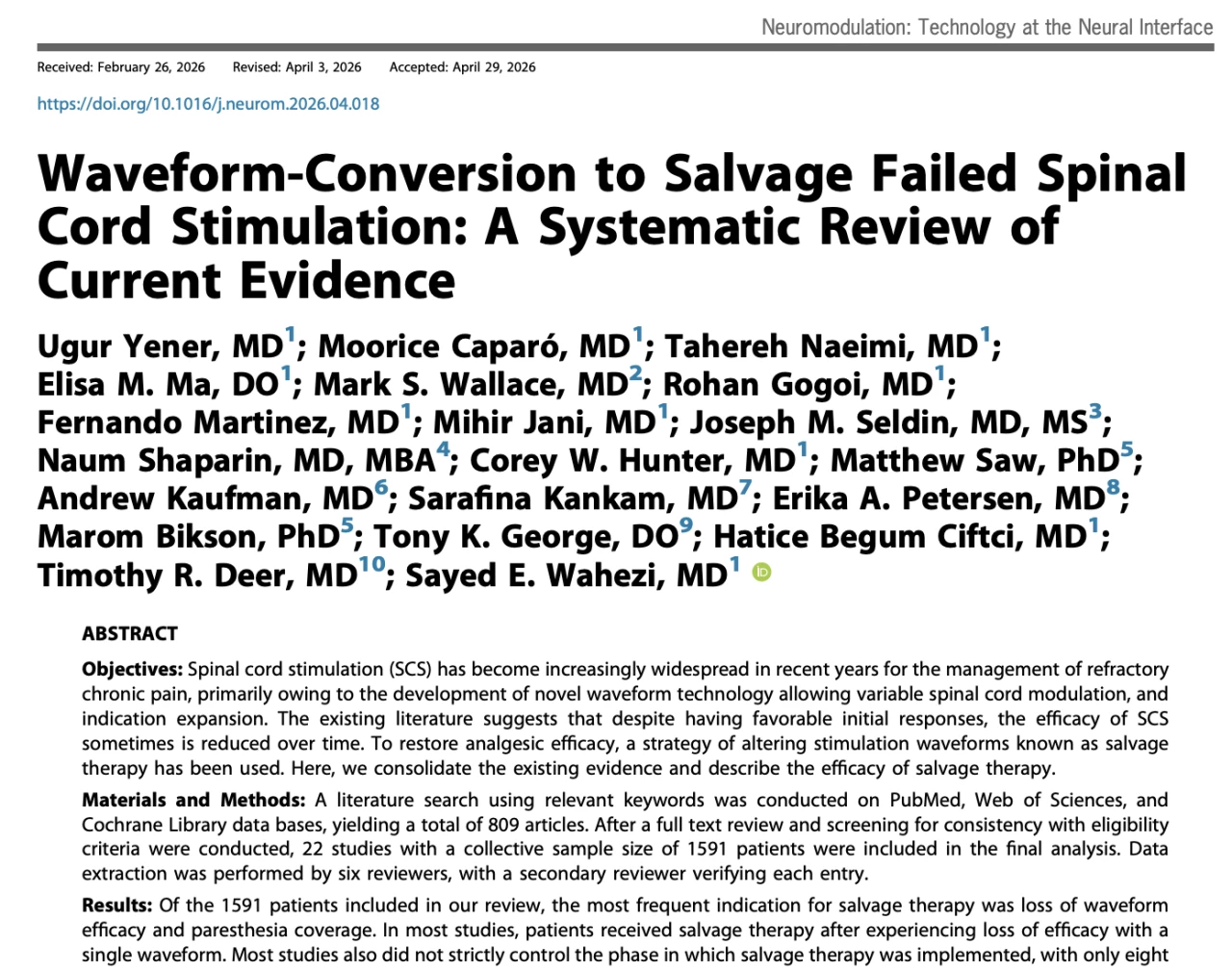
A systematic review published in Neuromodulation (Epub May 8, 2026) found that switching stimulation waveforms restored analgesic benefit in 685 of 879 salvage therapy attempts (77.9%) across 22 studies and 1,591 patients. The paper, led by Yener et al., pooled evidence on so-called waveform-conversion as a rescue strategy for spinal cord stimulation (SCS) that has lost efficacy.
The authors searched PubMed, Web of Science and Cochrane databases and screened 809 records to reach 22 eligible studies. Data extraction was performed by six reviewers with secondary verification. The most common reason for attempting waveform conversion was loss of analgesic effect and diminished paresthesia coverage after an initially successful SCS response.
Most studies applied salvage therapy after failure with a single waveform setting; only eight of the 22 studies reported salvage attempts confined to the trial phase. The review reports a broadly favorable short-term response rate to waveform switching but highlights variability in how and when salvage was implemented across studies.
The authors also note that many salvage approaches required hardware changes, including device revision or generator replacement, rather than simple reprogramming. They warn the long-term durability of waveform-based salvage remains uncertain and that the evidence base is heterogeneous.
Yener et al. conclude that waveform conversion can restore benefit for a subset of patients with failed SCS, but they call for prospective studies to define optimal patient selection, timing for intervention, and longer-term outcomes. (Neuromodulation. 2026 May 8. doi: 10.1016/j.neurom.2026.04.018. PMID: 42249871.)
Photo credit: static1.squarespace.com
Tags: spinal cord stimulation, waveform switching, salvage therapy, implantable neuromodulation, systematic review
Topics: Neuromodulation, Neuroprosthetics & neural implants