Researchers at the Medical University of Vienna and ETH Zurich report in Nature Medicine (2026) that an immersive virtual-reality platform paired with transcutaneous electrical nerve stimulation produced larger gains in arm and hand recovery than conventional rehabilitation in a randomized feasibility trial.
The system, called MultiSensy, uses VR goggles to place patients in interactive tasks that train reaching, grasping, pinching and forearm rotation. Surface electrodes deliver synchronous electrical stimulation to peripheral nerves, giving patients tactile sensations timed to virtual contact. The software adapts task difficulty to each person and records movement data during training.
The trial enrolled 34 people who had a stroke more than three months earlier. Participants were randomized to MultiSensy or to conventional rehabilitation (physiotherapy and occupational therapy). Both groups completed 12 sessions over three weeks. The study is published with DOI 10.1038/s41591-026-04486-4.
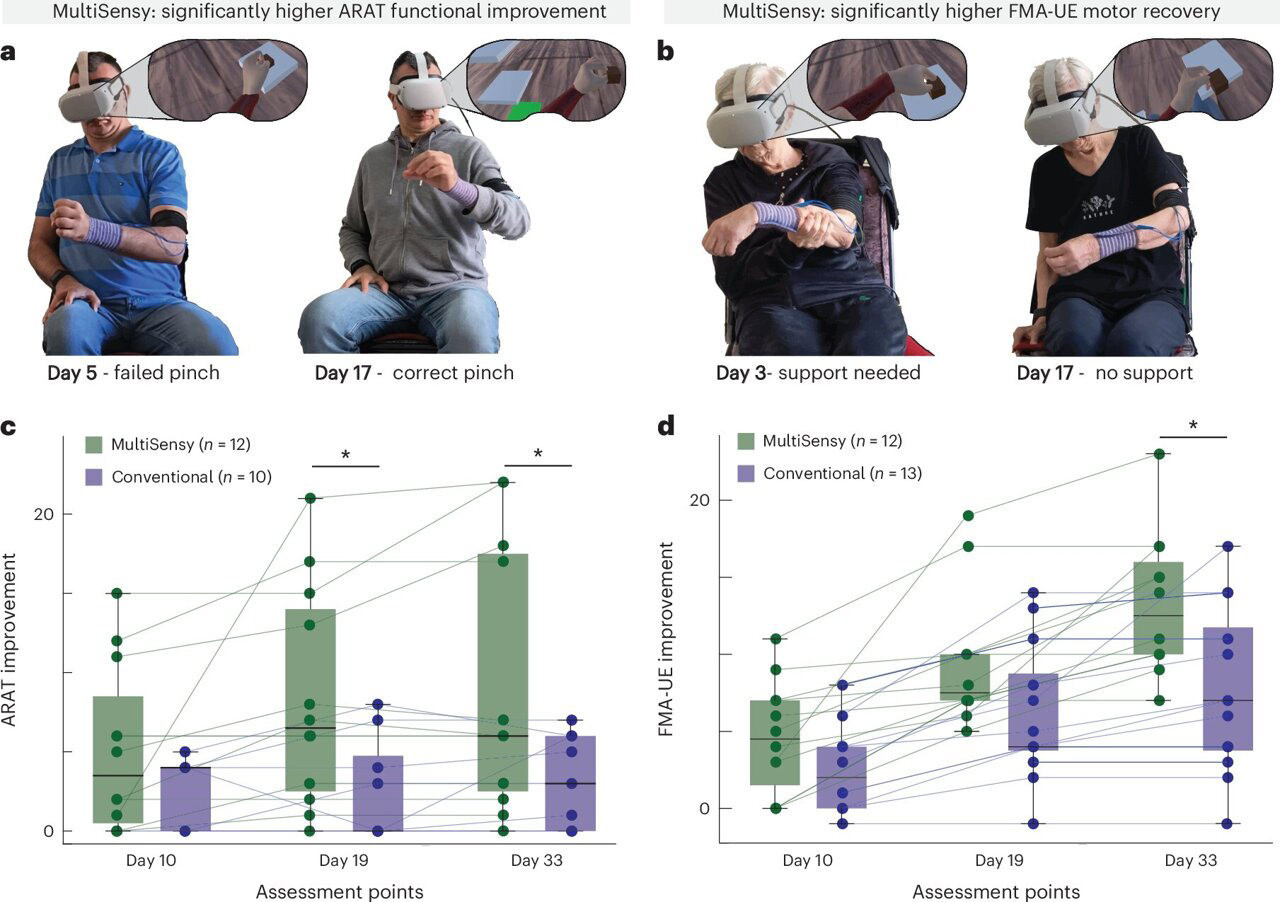
Patients using MultiSensy improved nearly twice as much on the Fugl-Meyer Assessment for the upper limb, a standard clinical measure of motor impairment, compared with controls, the authors report. The MultiSensy group also showed larger gains on the Action Research Arm Test, which measures functional arm and hand use. The paper adds that participants regained tactile sensation and reported more accurate perception of their affected arm.
"Our aim was to go beyond mere movement training," said study leader Stanisa Raspopovic (MedUni Vienna). "After a stroke, patients often have difficulty not only moving the affected limb, but also feeling it and perceiving it correctly. MultiSensy was developed to reconnect movement, sensation and body awareness during rehabilitation."
Lead author Valerio Aurucci (ETH Zurich) noted the system provides objective movement metrics clinicians can use to track progress. The authors describe these results as early clinical evidence and call for larger trials to confirm efficacy and test longer-term outcomes.
Photo credit: img-s-msn-com.akamaized.net
Tags: stroke rehabilitation, virtual reality, transcutaneous electrical nerve stimulation, sensory feedback
Topics: Non-invasive brain stimulation, Neuromodulation, Wearable neurotech