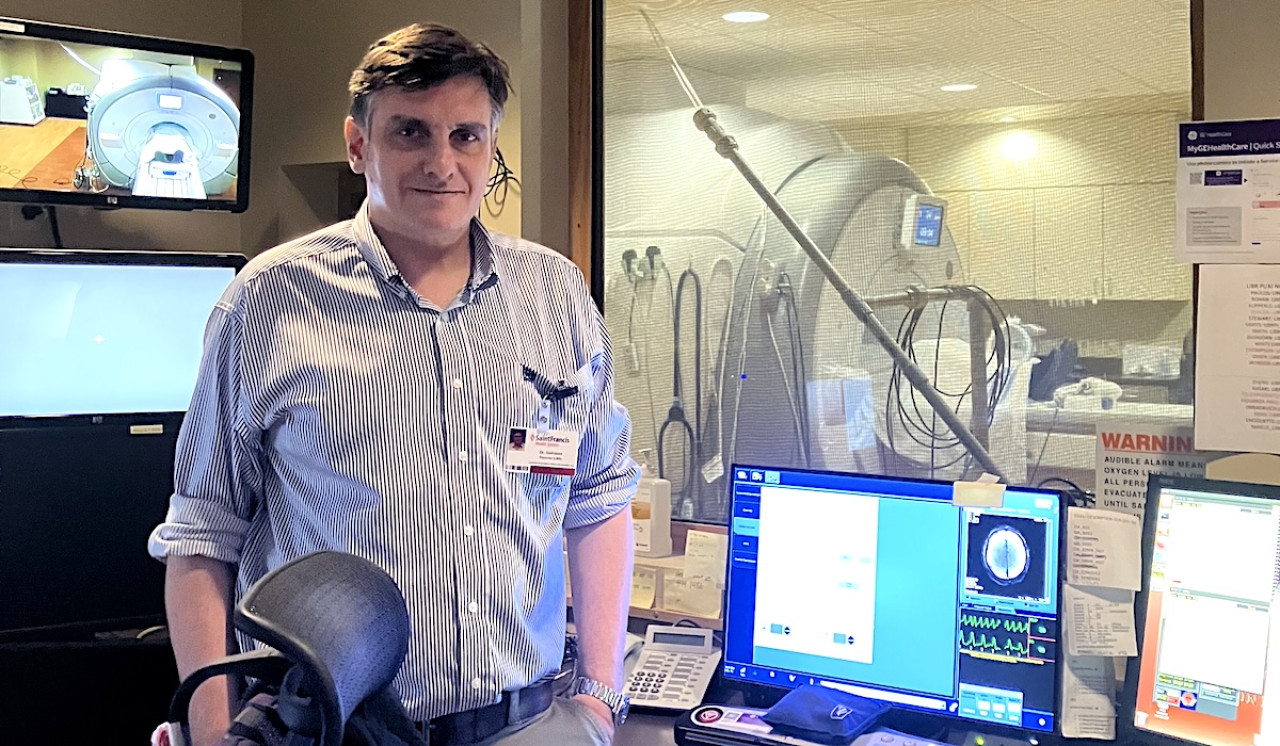
Researchers at the Laureate Institute for Brain Research (LIBR) in Tulsa are conducting a federally funded clinical trial using low‑intensity focused ultrasound (LIFU) to modulate deep brain circuits in people with treatment‑resistant depression.
Principal investigator Dr. Salvador Guinjoan said the team delivers anatomically targeted, low‑intensity ultrasound to white‑matter tracts using each participant’s structural brain image and navigation software. The primary targets are the anterior limb of the internal capsule, a band of axons linking the thalamus and prefrontal and reward regions, and parts of the thalamus.
"When you intervene directly on the circuits and observe a response, be it behavioral or imaging, most people will agree that that approach is causation — a causal link between the brain circuit that you regulate and the behavior or symptom," Guinjoan said. He also cautioned the work is exploratory: "It’s not curing, at least not at this stage."
LIFU is noninvasive and reversible, the researchers say. The technique aims to disrupt or modulate specific wiring without surgery or implanted electrodes, allowing investigators to probe deep circuit function previously accessible mainly via invasive methods such as deep brain stimulation.
The trial sits alongside other local treatments for people with difficult‑to‑treat depression. Patient Kimber Jones, who has long‑running major depressive disorder, described relief after treatment with oral Auvelity and the nasal esketamine product Spravato. Auvelity was approved by the FDA in 2022; Spravato received initial FDA approval in 2019 and an expanded approval in 2025, the source notes. Jones said the combination reduced suicidal thinking and restored the capacity to feel joy, though her improvement has since plateaued.
About one‑third of people treated for depression do not respond to standard therapies, the story notes, and Oklahoma’s depression metrics have been higher than the national average in recent years (Kaiser Family Foundation, 2023).
LIBR colleague Dr. Chun Chien Fan published a genetic and cognitive analysis in JAMA Psychiatry using data from 292,663 people that linked genetic risk for trait anxiety/negative thinking and decision‑making differences with higher risk of treatment resistance. Guinjoan said his next step is to use mechanistic data from LIFU studies to attempt symptom modification in clinical settings if findings support it.
Dr. Martin Paulus, LIBR director, urged patients and clinicians to keep communication open about treatment effectiveness and side effects, calling care a "collaborative relationship" in an August 2025 webinar.
Photo credit: nondoc.com
Tags: low-intensity focused ultrasound, treatment-resistant depression, neuromodulation, anterior limb of internal capsule, esketamine (Spravato)
Topics: Non-invasive brain stimulation, Neuromodulation, Neuroscience & neuroplasticity