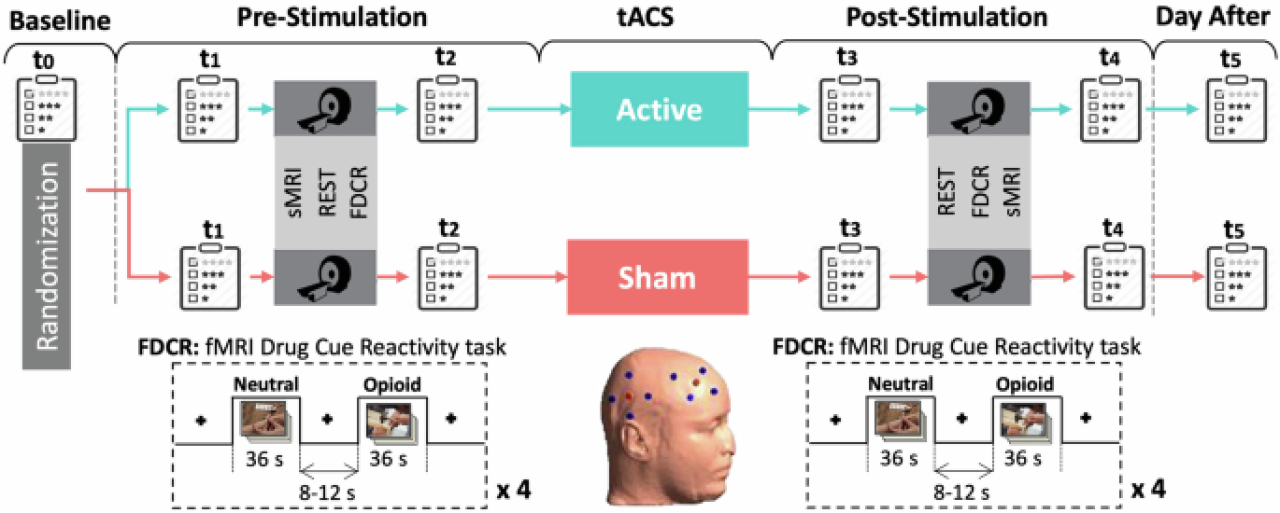
In a pre-registered, triple‑blind, randomized sham‑controlled trial (NCT03907644) published 26 June 2026 in Molecular Psychiatry, Soleimani et al. report that a single 20‑minute session of in‑phase 6 Hz high‑definition transcranial alternating current stimulation (tACS) over right dorsolateral prefrontal (F4) and inferior parietal (P4) cortex reduced drug‑cue–evoked BOLD responses in subcortical targets of addiction.
The study randomized 60 men with opioid use disorder recruited from June 2019 to June 2023 at a residential treatment center in Tulsa, Oklahoma. Active stimulation used two 4×1 HD montages (F4 and P4) at 2 mA peak‑to‑peak for 20 minutes; sham delivered brief ramp periods only. Researchers collected structural MRI, resting‑state fMRI, and a block‑design drug cue reactivity task before and after stimulation.
Primary neuroimaging results showed a significant time × group interaction: active tACS produced greater reductions in cue‑related activity in the striatum and in limbic regions including the amygdala, ventral tegmental area and posterior cingulate cortex compared with sham. Task‑dependent connectivity (gPPI) increased within the frontoparietal network and decreased between the parietal seed and ventral striatum and medial amygdala after active stimulation.
Behavioral craving measured by a visual analog scale fell after the session in both groups, with no significant active‑vs‑sham difference. However, within the active arm greater increases in frontoparietal connectivity correlated with larger craving reductions (r = −0.37, p = 0.05). Individualized electric field modeling showed that higher right‑frontal field strength predicted larger frontoparietal connectivity increases in the active group (r = 0.43, p = 0.02), consistent with a dose‑dependent neural effect.
The authors note key limitations: the sample was male‑only, the protocol used a single stimulation session, and the study assessed only acute neural and subjective effects without long‑term clinical follow‑up. They recommend multi‑session and imaging‑guided targeting to test whether the observed network engagement translates into durable clinical benefit. Data and code are available at the authors' repository: github.com/SoleimaniGhazaleh/Frontoparietal-tACS-OUD.
Photo credit: media.springernature.com
Tags: tACS, opioid use disorder, fMRI, frontoparietal network
Topics: Non-invasive brain stimulation, Transcranial electrical stimulation, Neuromodulation