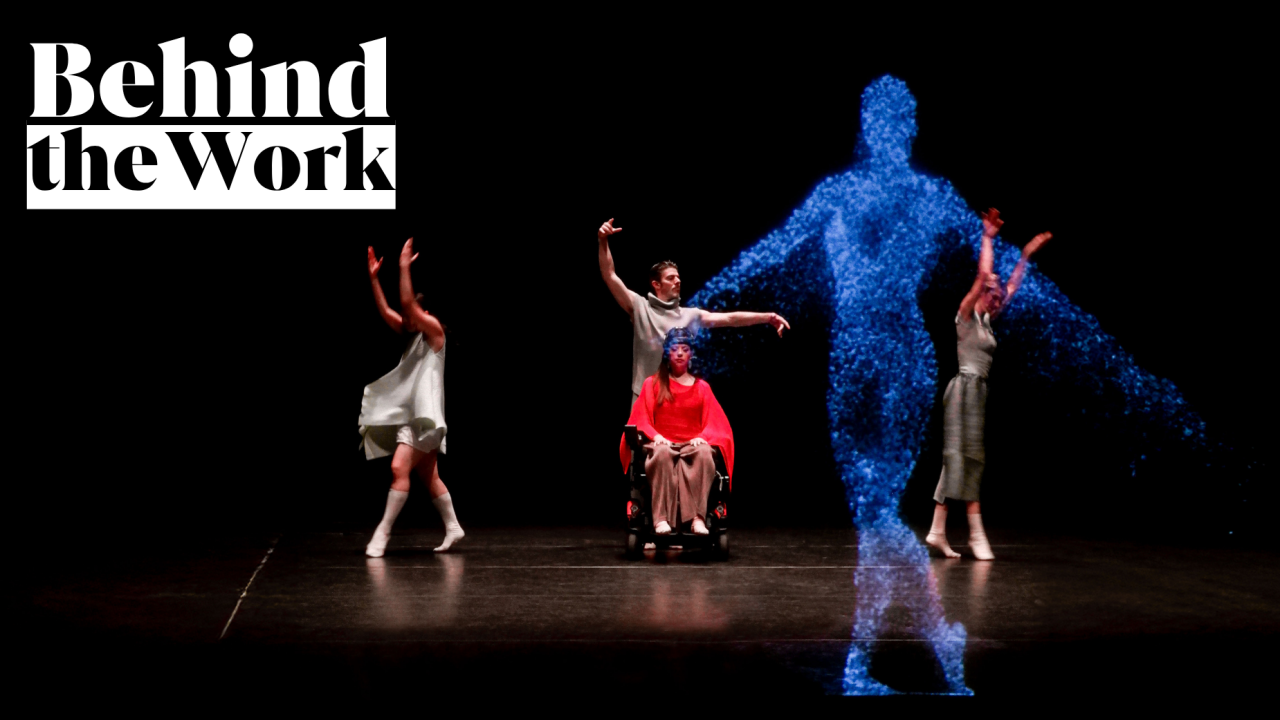
Dentsu Lab and NTT say their Project Humanity team used a non‑invasive EEG system to let Breanna Olson, a former professional dancer living with ALS, control a digital avatar and perform live in mixed reality at the OBA Theatre in Amsterdam last December.
The piece, called “Waves of Will,” is part of a longer collaboration between Dentsu Lab and NTT under the programmes All Players Welcome and Project Humanity. The teams described the project as a design effort to restore personal expression for people who lose voluntary motor control in advanced stages of ALS.
The technical approach translated the imagined action of closing the left or right hand into mouse movement, which then controlled an on‑stage avatar. Dentsu Lab and NTT said the setup ran on a lightweight EEG headset and a laptop, and used two custom user interfaces — “Word Selection” for designing the performance and “Avatar control” for navigation. NTT’s R&D group applied machine learning to reduce accuracy loss when brain signals drift, the teams said.
Breanna Olson, who worked closely with the creators, told the project team early on: “Even with ALS, I still want to be someone who can move and inspire others.” Dentsu Lab’s executives said her involvement shaped the choreography and interface requirements; Pascal Rotteveel described how inviting a person with a physical disability into the design process opened new creative choices.
Dentsu Lab and NTT said the work is not a commercial product. The model continues to be trained with additional users and the teams are presenting the work publicly; the project received a feature on BBC World News. The groups framed the demonstration as proof of concept for non‑invasive EEG control in contexts ranging from communication to performance.
Photo credit: d3q27bh1u24u2o.cloudfront.net
Tags: EEG headset, brain–computer interface, ALS, avatar control, mixed reality
Topics: EEG & neuro-sensing headsets, Brain–computer interfaces, Wearable neurotech