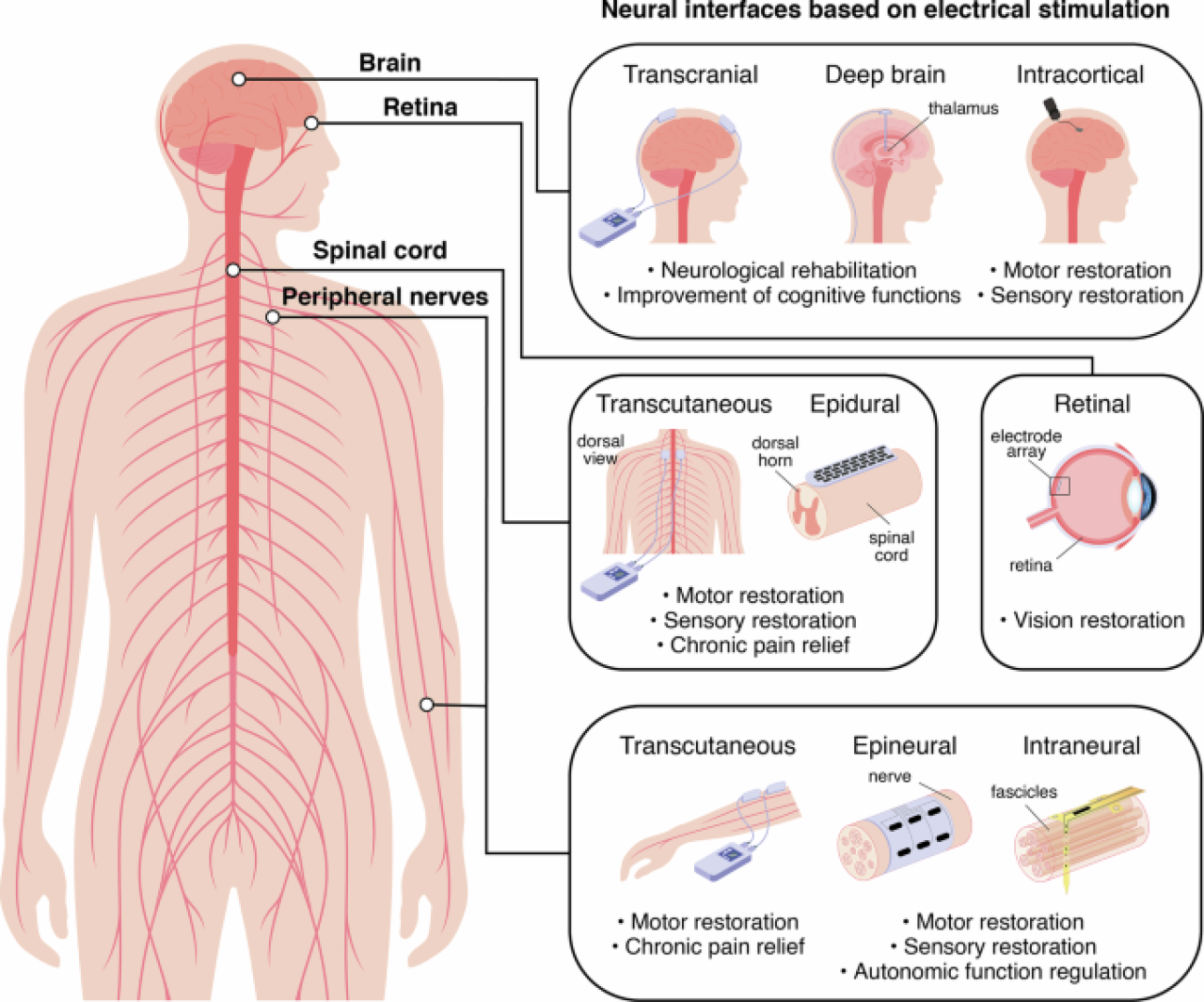
A review titled "The optimization of neuroprosthetic interfaces relying on biophysical and surrogate digital twins" synthesizes decades of modeling work across deep brain, spinal cord, peripheral nerve, vagus and retinal interfaces and makes a practical case for pairing high-fidelity biophysical simulations with fast surrogate models.
The authors survey patient-specific finite-element and multicompartment neuron models that reproduce electric fields and axon responses. They contrast those detailed approaches with surrogate tools—machine-learning predictors, reduced-order models and Bayesian or genetic optimizers—that run orders of magnitude faster and can be used for real-time parameter search or closed-loop calibration.
The review highlights concrete gains reported in the literature: validated pipelines that predict vagus nerve stimulation thresholds, ANN and convolutional-net predictors of activation thresholds for cortical and DBS electrodes, and automated sample-specific workflows such as ASCENT for peripheral nerves. It also notes examples of model-driven device design and programming, from multipolar electrode placement to optimized temporal stimulation patterns.
The authors flag recurring barriers to clinical translation. Anatomical variability, uncertainty in tissue conductivities, electrode–tissue interface effects, frequency-dependent tissue properties and limits of the quasi-static approximation all reduce model reliability unless models are validated against in vivo data. They point to a need for more head-to-head validation studies and for reporting standards that make patient-specific models reproducible.
As a practical roadmap, the review recommends combining detailed biophysical models for offline design and safety assessment with surrogate digital twins for rapid personalization and online control. It also urges wider use of open-source tools and shared datasets to speed validation and regulatory acceptance.
The review does not present new experimental data. Instead it maps methods, cites recent validation studies, and frames a pathway to scale individualized neurostimulation and neuroprosthetic programming using hybrid modelling approaches.
Photo credit: media.springernature.com
Tags: biophysical modeling, surrogate models, neuroprosthetics, spinal cord stimulation, vagus nerve stimulation
Topics: Neuroprosthetics & neural implants, Neuromodulation, Deep brain stimulation