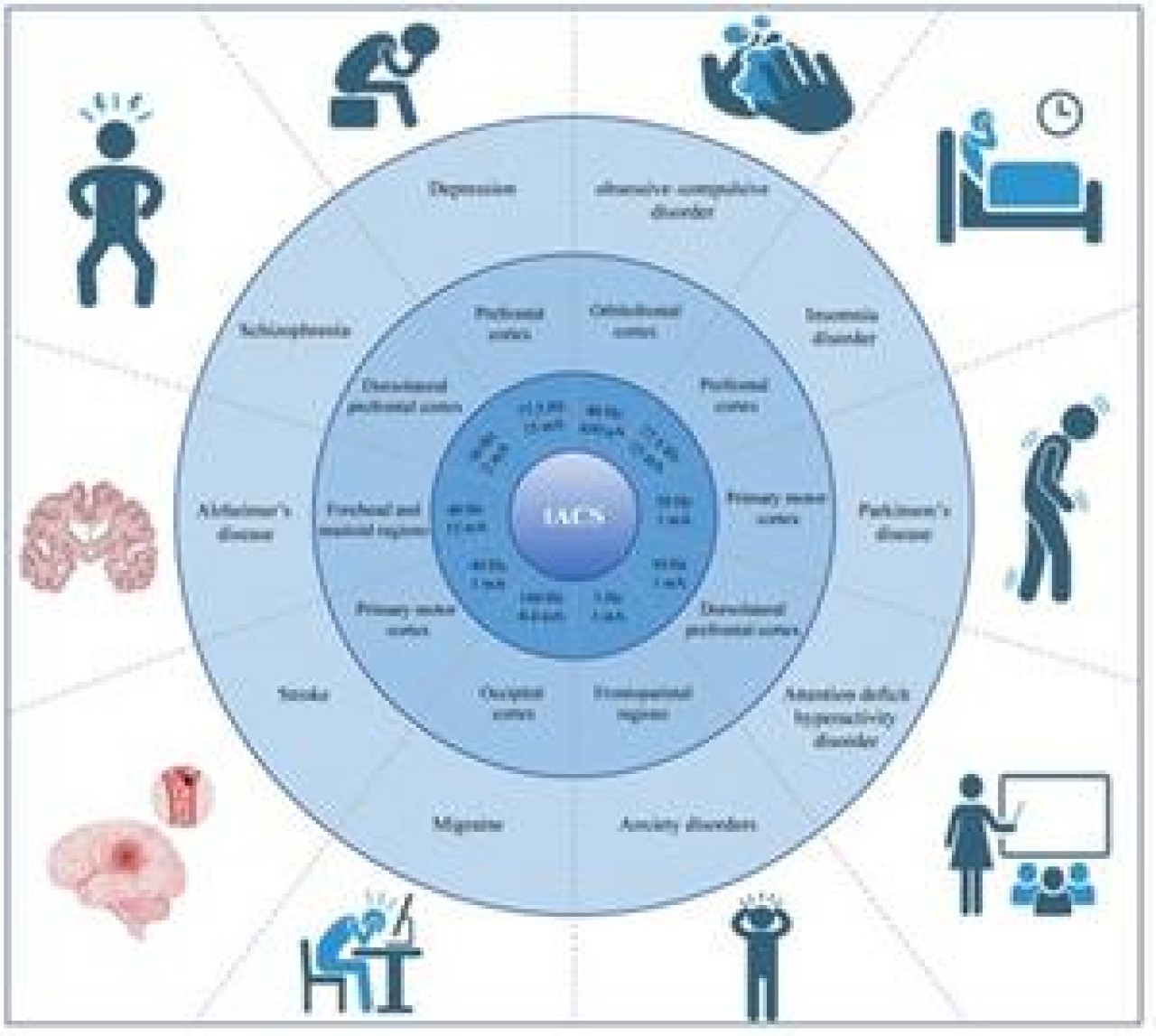
Researchers led by Professor Hongxing Wang published a review in the Chinese Medical Journal on 5 April 2026 that summarizes mechanisms and clinical applications of transcranial alternating current stimulation (tACS). The authors define tACS as noninvasive, sinusoidal alternating-current stimulation used to modulate brain oscillations.
The review groups proposed therapeutic mechanisms into four pathways. tACS can shift oscillatory activity in theta (4–8 Hz), alpha (8–13 Hz), beta (13–30 Hz) and gamma (30–100 Hz) bands. The authors also describe synaptic plasticity effects driven by spike-timing-dependent plasticity and NMDA receptors, modulation of neurotransmitters such as serotonin, norepinephrine, dopamine and β-endorphin, and enhancement of functional and structural network connectivity between prefrontal and limbic regions.
Clinical signals cited in the review span multiple disorders but come mostly from small studies and single-center trials, the authors note. Examples highlighted include randomized controlled trials using 77.5 Hz tACS at up to 15 mA applied to prefrontal and bilateral mastoid sites that reported antidepressant effects, including in treatment-resistant cases when given twice daily. The review cites gamma (40 Hz) protocols that reportedly improved episodic memory and default-mode–hippocampal connectivity in Alzheimer’s cohorts and describes 40 Hz response patterns as a potential biomarker for progression risk. Other reported uses include gamma and alpha tACS in schizophrenia, beta–gamma high-definition tACS for obsessive–compulsive disorder with symptom reductions lasting at least three months, EEG-guided personalized tACS for Parkinson’s motor symptoms, gait-synchronized tACS in stroke rehabilitation, and 77.5 Hz protocols for chronic insomnia and migraine.
The authors call for larger, multicenter randomized double-blind trials to define optimal parameters (frequency, intensity, phase, duration) and long-term safety. They flag technical limits in spatial resolution and penetration depth and point to temporal interference and closed-loop, EEG-guided systems as avenues for improving precision. The work was supported by the National Natural Science Foundation of China (grant 82371490). The authors declared no conflicts of interest. The review is available at https://doi.org/10.1097/cm9.0000000000004012.
Photo credit: mediasvc.eurekalert.org
Tags: tACS, transcranial electrical stimulation, depression, Alzheimer's disease, closed-loop neuromodulation
Topics: Transcranial electrical stimulation, Non-invasive brain stimulation, Neuromodulation