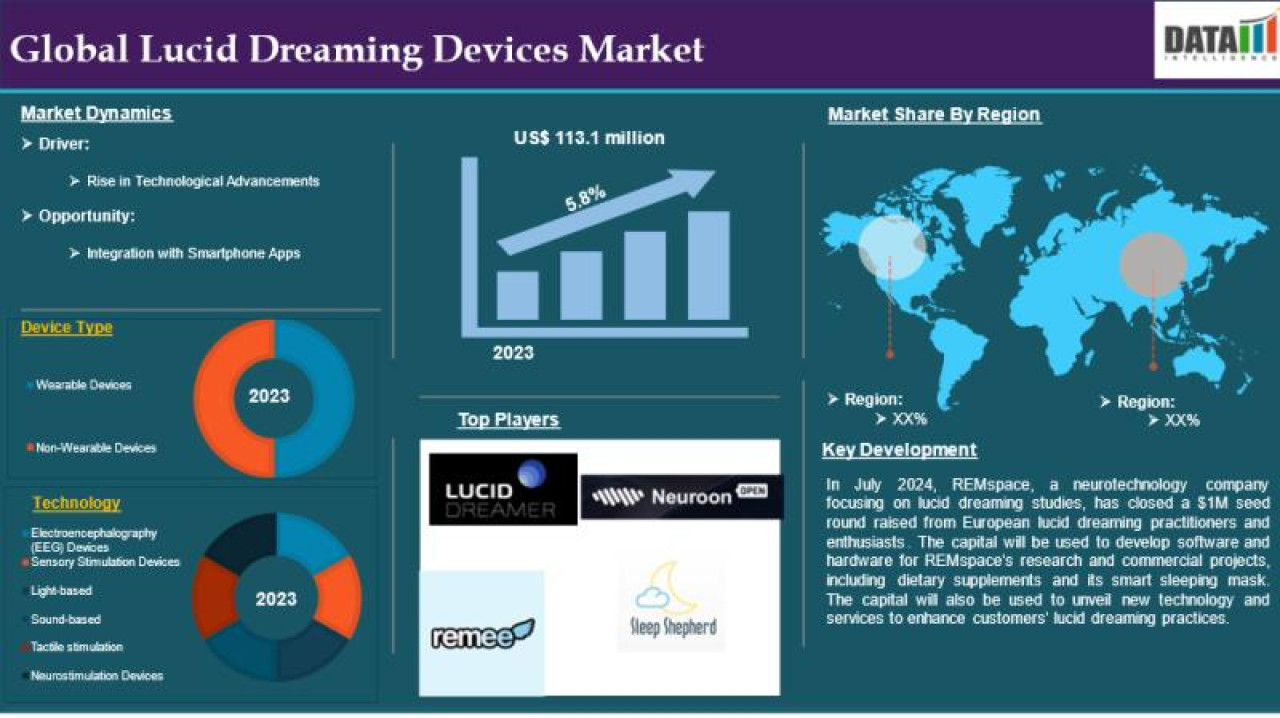
Market-research firm DataM Intelligence released a report projecting the global lucid-dreaming devices market will grow from US$113.1 million in 2023 to US$201.8 million by 2033, at a compound annual growth rate (CAGR) of 5.8% for the 2025–2033 forecast period.
The report singles out North America as the largest regional market, with a 40% share driven mainly by the United States. Europe is reported at 28% and Asia Pacific at 22%, with Japan and expanding e-commerce in China and India noted as growth factors.
DataM Intelligence identifies wearables—masks, headbands and wristbands—that detect REM sleep and deliver light, sound or vibration cues as the dominant device category. The analysis highlights two technology trends: REM-detection sensors for timing cues and EEG-based monitoring for more detailed sleep-stage tracking. Mobile apps for sleep tracking and dream journaling are listed as common integrations.
The report also lists recent company and research activity through late 2025 and early 2026. Examples cited include:
- January 2026: Prophetic AI advancing a “Halo” wearable that the report says uses AI-guided ultrasound stimulation; closed-user testing in the U.S. focused on targeting prefrontal activity during REM.
- November 2025: iWinks updated firmware and its Aurora app to improve REM detection and customizable light cues.
- February 2026: Dreem expanded its EEG headband capabilities, noted as being explored for lucid-dreaming use by third-party developers.
- September 2025: MIT-affiliated researchers continued experimental work on wearable sleep interfaces inspired by Dormio.
- December 2025: The European Sleep Research Society reported growing clinical interest in lucid dreaming for conditions such as PTSD and nightmares.
The report warns of persistent hurdles: limited large-scale clinical validation, inconsistent user results, and relatively high product costs, which it says restrict mainstream medical adoption despite growing consumer interest.
DataM Intelligence published the release on openPR and markets the study as a resource for corporate strategy and competitive tracking.
Photo credit: cdn.open-pr.com
Tags: lucid dreaming devices, wearable sleep tech, REM detection, EEG headbands, sleep therapy
Topics: Wearable neurotech, EEG & neuro-sensing headsets, Sleep technology