Researchers at Sharif University of Technology report in Scientific Reports (published 27 March 2026) that electrochemically deposited polydopamine-doped PEDOT (PEDOT-PDA) films on titanium nitride (TiN) microelectrodes markedly reduce impedance and improve cell adhesion compared with uncoated TiN and gold references.
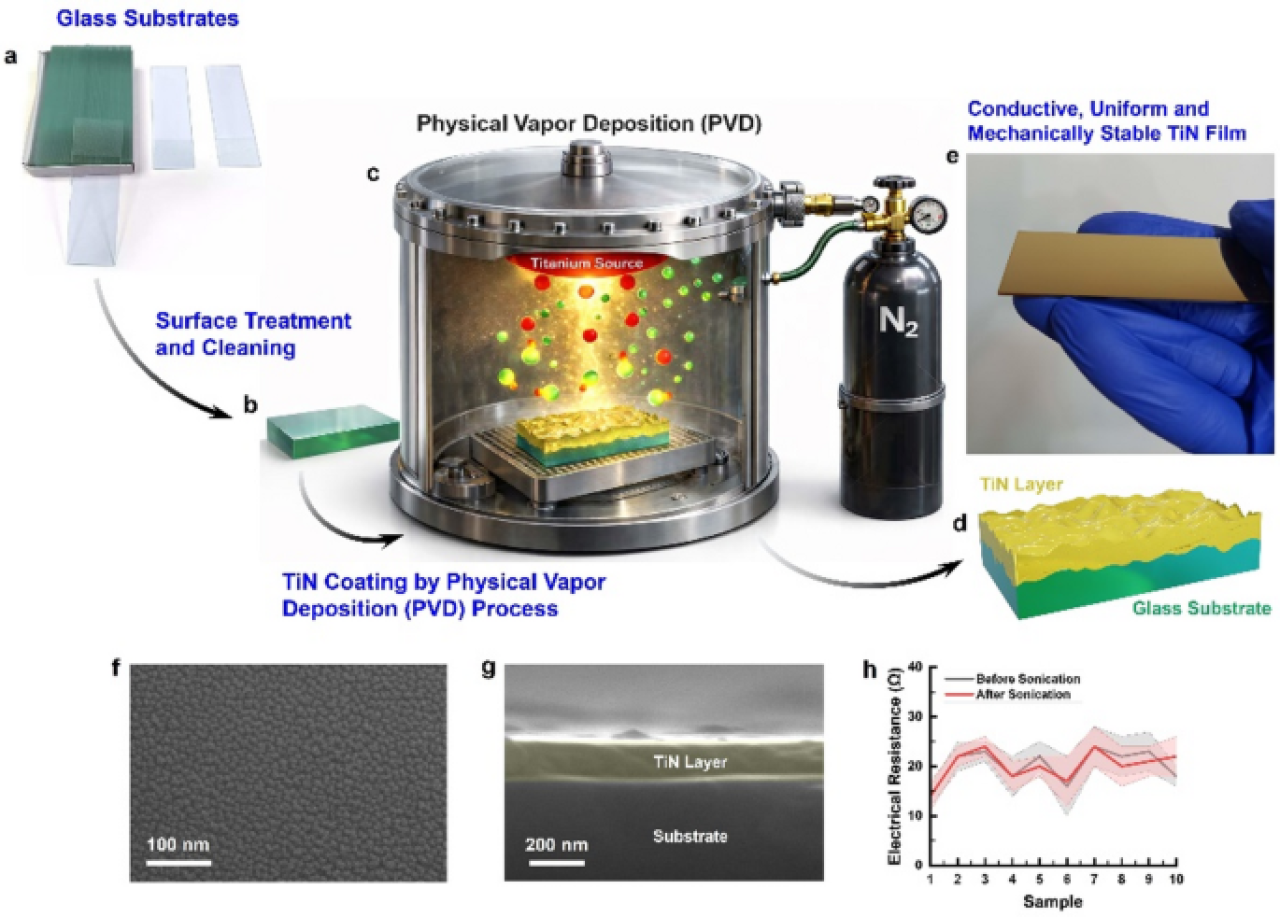
The team, led by Shahab Ahmadi Seyedkhani, fabricated PEDOT and PEDOT-PDA layers by galvanostatic electropolymerization on TiN-coated glass. At 1 kHz the PEDOT-PDA coating measured ~270 Ω, versus ~420 Ω for pure PEDOT, ~730 Ω for TiN and ~4,700 Ω for a commercial Au electrode. The composite film was ~200 nm thick, had nanoscale roughness (AFM Ra ≈ 14.2 nm) and a water contact angle below 10°.
Biological tests used L929 fibroblasts in vitro. The conditioned-media MTT assay returned ~85% viability on PEDOT-PDA after 48 hours, meeting ISO 10993-5 cytocompatibility criteria used by the authors. Live/dead staining and FESEM showed well-spread cells with extended filopodia on the PEDOT-PDA surface, consistent with the material’s increased wettability and nanoscale texture.
The group paired experiments with molecular dynamics (MD) and MM/PBSA analysis to probe membrane interactions. MD runs at 298 K and 310 K produced more negative binding energies for PDA-containing interfaces (for example ≈ −244 kcal/mol for a PEDOT/PDA arrangement at 310 K versus ≈ −31 kcal/mol for pure PEDOT). A configuration with PDA at the membrane-facing surface also showed a large increase in lateral diffusion (~132 μm²/s) versus PEDOT-only models, which the authors link to altered membrane interaction dynamics.
The paper’s data are in vitro and computational; the authors do not report in vivo testing or chronic stability results in this article. The full report is available in Scientific Reports: Ahmadi Seyedkhani et al., 2026.
Photo credit: media.springernature.com
Tags: PEDOT, polydopamine, neural interfaces, impedance, molecular dynamics
Topics: Neuroprosthetics & neural implants, Brain–computer interfaces, Neuroscience & neuroplasticity