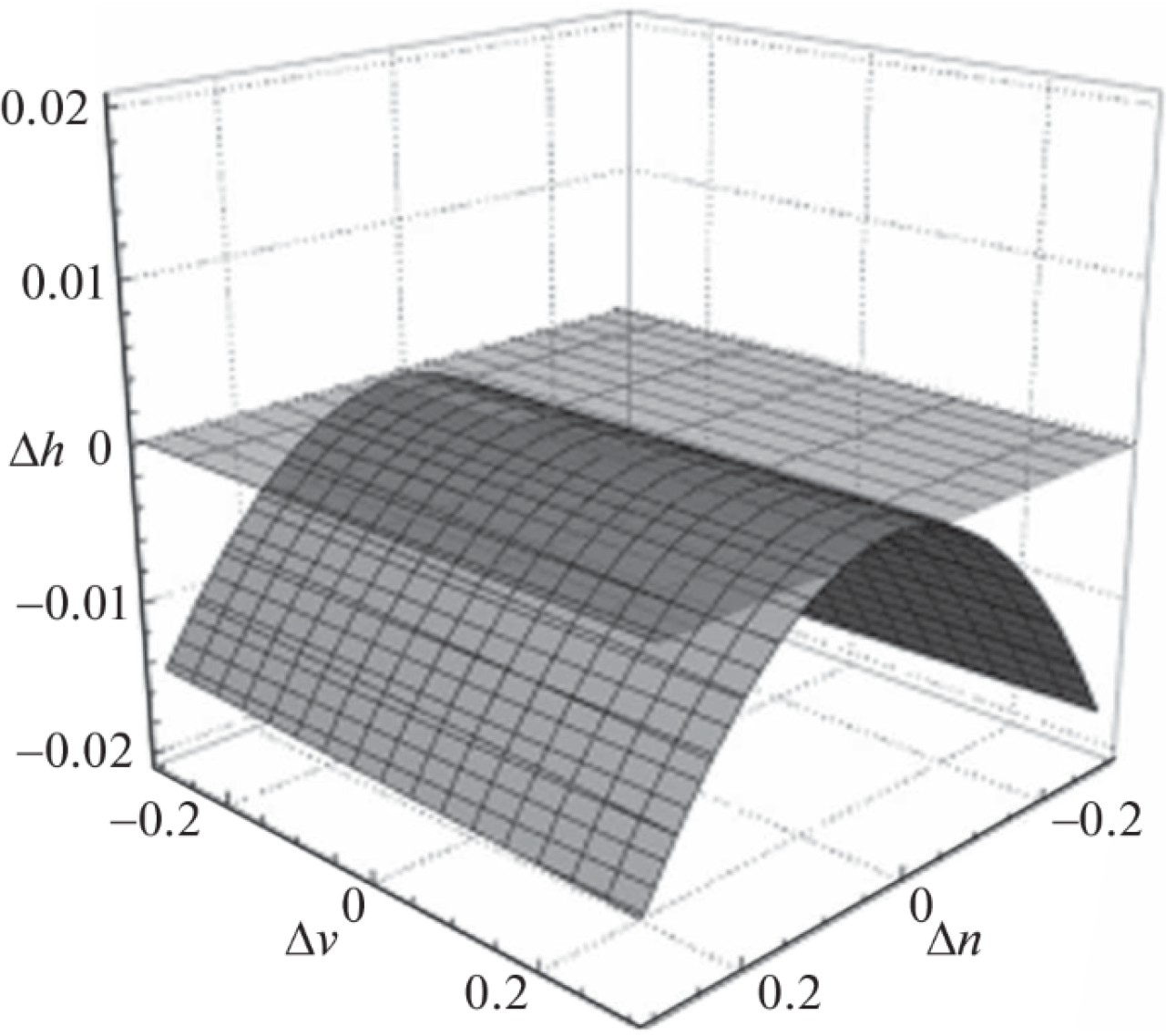
A paper in Moscow University Mechanics Bulletin reports that the Soto–Alexandrov three‑variable model of the afferent primary neuron (APN) of the vestibular system can be approximated by a two‑variable system near an Andronov–Hopf bifurcation. The authors construct a central invariant manifold and show the potassium inactivation variable hK can be taken approximately constant at its stationary value (hK ≈ 0.875), reducing the model to two differential equations plus an algebraic relation.
The reduction applies on the left neighborhood of the bifurcation point where the synaptic current Isyn is near Isyn* ≈ 1.3325 μA/cm². For the linearization at that point the eigenvalues are λ1,2 = ±0.3800 i and λ3 = −0.0086, which supports a two‑dimensional central manifold carrying the nontrivial dynamics. The authors use a change to Jordan normal form and expand the system to second order to derive an explicit quadratic approximation of the manifold in the transformed coordinates; when transformed back, the algebraic relation projects to Δh ≈ 0 and hK ≈ 0.875 in the original variables.
Numerical comparison in the paper shows the reduced second‑order system reproduces the projection of the full model’s limit cycle onto the plane hK = 0.875. The full third‑order system is bistable for constant I_syn in the interval [0.99, 1.3325) μA/cm², with a stable equilibrium and an orbitally stable limit cycle; the Hopf point sits at the right boundary of that interval. The authors note strong nonlinearities prevent deriving an analytic closed form for the invariant manifold as a function of the bifurcation‑parameter μ.
The paper frames the reduction as a tool to simplify analysis of direct and inverse transitions and to construct attainability sets for the APN model. It also points to relevance for studies of galvanic vestibular stimulation, which act through the synaptic current, but does not present new experimental stimulation data.
Photo credit: media.springernature.com
Tags: vestibular afferent neuron, model reduction, invariant manifold, Andronov–Hopf bifurcation, galvanic vestibular stimulation
Topics: Galvanic vestibular stimulation, Neuroscience & neuroplasticity, Neuromodulation