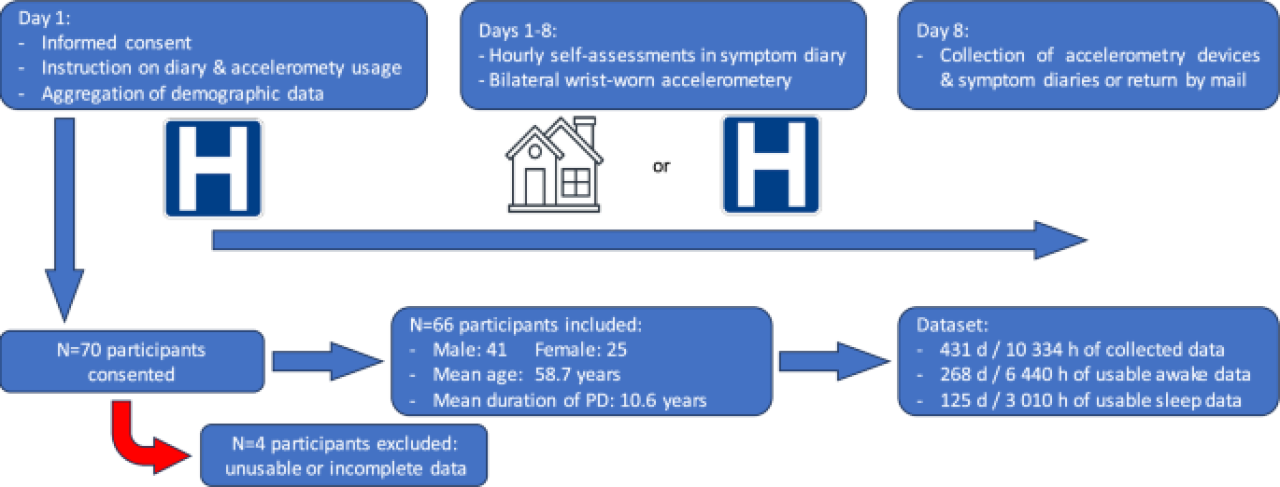
Researchers at the University of Cologne and Charité have published an open dataset that pairs hourly symptom diaries with bilateral wrist accelerometry from 66 people with Parkinson’s disease. The data, released alongside a Scientific Data paper published 9 April 2026, was collected between September 2022 and June 2023 and is available on the Open Science Framework: https://osf.io/5xvwn/ (DOI: 10.17605/OSF.IO/5XVWN).
The study enrolled 70 participants and retained 66 for the final dataset (41 male, 25 female; mean age 58.7 years; mean disease duration 10.6 years). Each participant wore GENEActiv three-axis accelerometers on both wrists for up to seven days while completing paper symptom diaries at hourly intervals. The sensors recorded raw acceleration at 100 Hz and logged light and skin temperature to help mark wear time.
The authors report 430.6 total days of accelerometry and diary collection and 393.8 days with usable, simultaneous diary-and-sensor data. Of those, 268.3 days were recorded while participants were awake and 125.4 while asleep. Data loss was 4.2% for accelerometry and 2.6% for diary entries; those gaps are annotated in the shared files. The dataset also includes demographic and clinical metadata, UPDRS-III scores, and example Matlab scripts for extraction and figure generation.
The stated purpose is to provide a resource for validating and developing algorithms that classify Parkinsonian motor states and fluctuations against the conventional reference of patient symptom diaries. The paper notes existing gaps in clinical validation and long-term compliance for wearable monitoring and positions this dataset as a larger, open benchmark for comparing accelerometer-derived metrics to diary records.
Ethics approval and trial registration are documented (University of Cologne IRB vote 21-1569; German Clinical Trials Register DRKS00028636). The authors did not perform additional device validation in this study, citing the GENEActiv device’s prior validation and earlier device comparisons reported in their lab. Code and data access instructions are included in the OSF record.
Photo credit: media.springernature.com
Tags: Parkinson's disease, accelerometry, wearable sensors, symptom diary, open dataset
Topics: Wearable neurotech, Neuroscience & neuroplasticity, Sleep technology