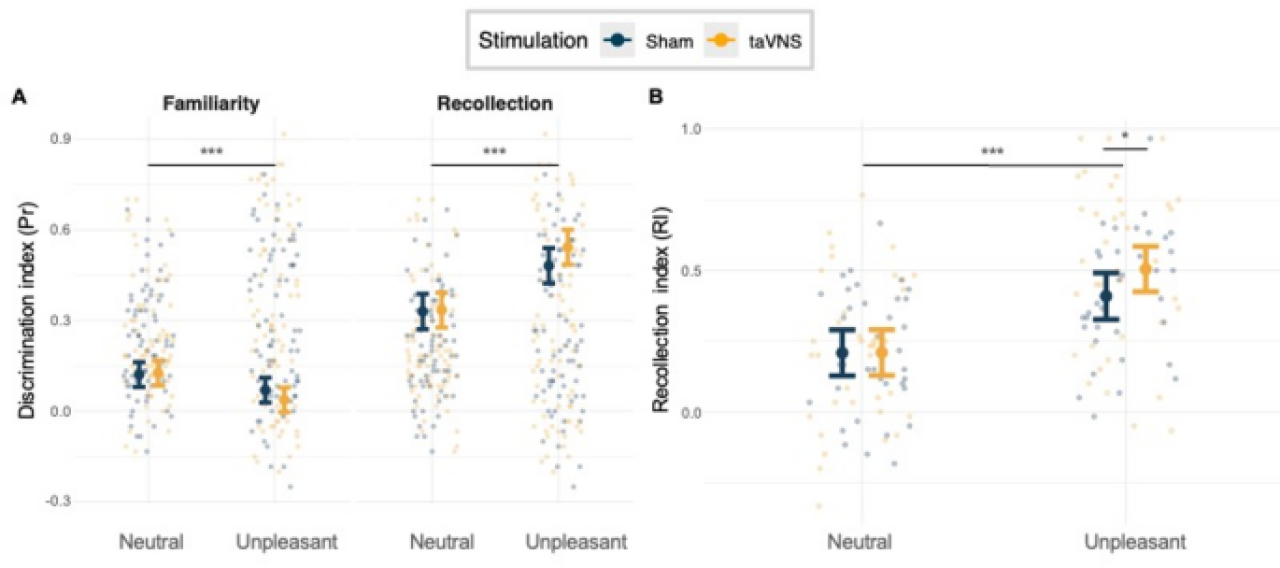
Researchers at the University of Potsdam report that transcutaneous auricular vagus nerve stimulation (taVNS) applied during memory retrieval increased recollection for emotionally unpleasant images but did not improve overall recognition. The peer-reviewed study was published in Scientific Reports on 23 May 2026 (doi:10.1038/s41598-026-53772-1).
The experiment used a two-day, randomized, single-blind, between-subject design with 75 healthy students. Participants encoded 120 images (60 neutral, 60 unpleasant) in an incidental encoding session and returned one week later for a recognition test. Stimulation was delivered only during the 33-minute recognition session: 38 participants received taVNS and 37 received a sham (left earlobe) montage.
Behavioral analysis separated high-confidence “recollection” responses from lower-confidence “familiarity” judgments. The authors report a selective increase in recollection-based discrimination for unpleasant images under taVNS. There was no global improvement in overall recognition sensitivity, and familiarity-based performance was not enhanced. The paper describes the effect size as small-to-medium and calls for replication.
Stimulation used a Cerbomed CMO2 unit with titanium electrodes on the left cymba conchae for taVNS and on the left earlobe for sham. Parameters: 25 Hz, 250 µs pulse width, alternating 30 s on/30 s off; intensity was individually titrated above sensory and below pain thresholds. Ethics approval and the protocol are noted in the paper, and the authors have posted data and analysis scripts on the Open Science Framework (https://osf.io/rqs6p/).
The study does not record locus coeruleus noradrenergic activity or other direct physiological mediators, and it was single‑blind, so the authors highlight limits on mechanism and call for follow-up work with physiological markers, double‑blind designs, and larger samples. They suggest the result supports a role for vagal-afferent modulation of recollection for emotionally salient material and note possible clinical or forensic implications if the finding replicates.
Photo credit: media.springernature.com
Tags: taVNS, vagus nerve, emotional memory, recollection, neuromodulation
Topics: Vagus nerve & taVNS, Neuromodulation, Non-invasive brain stimulation