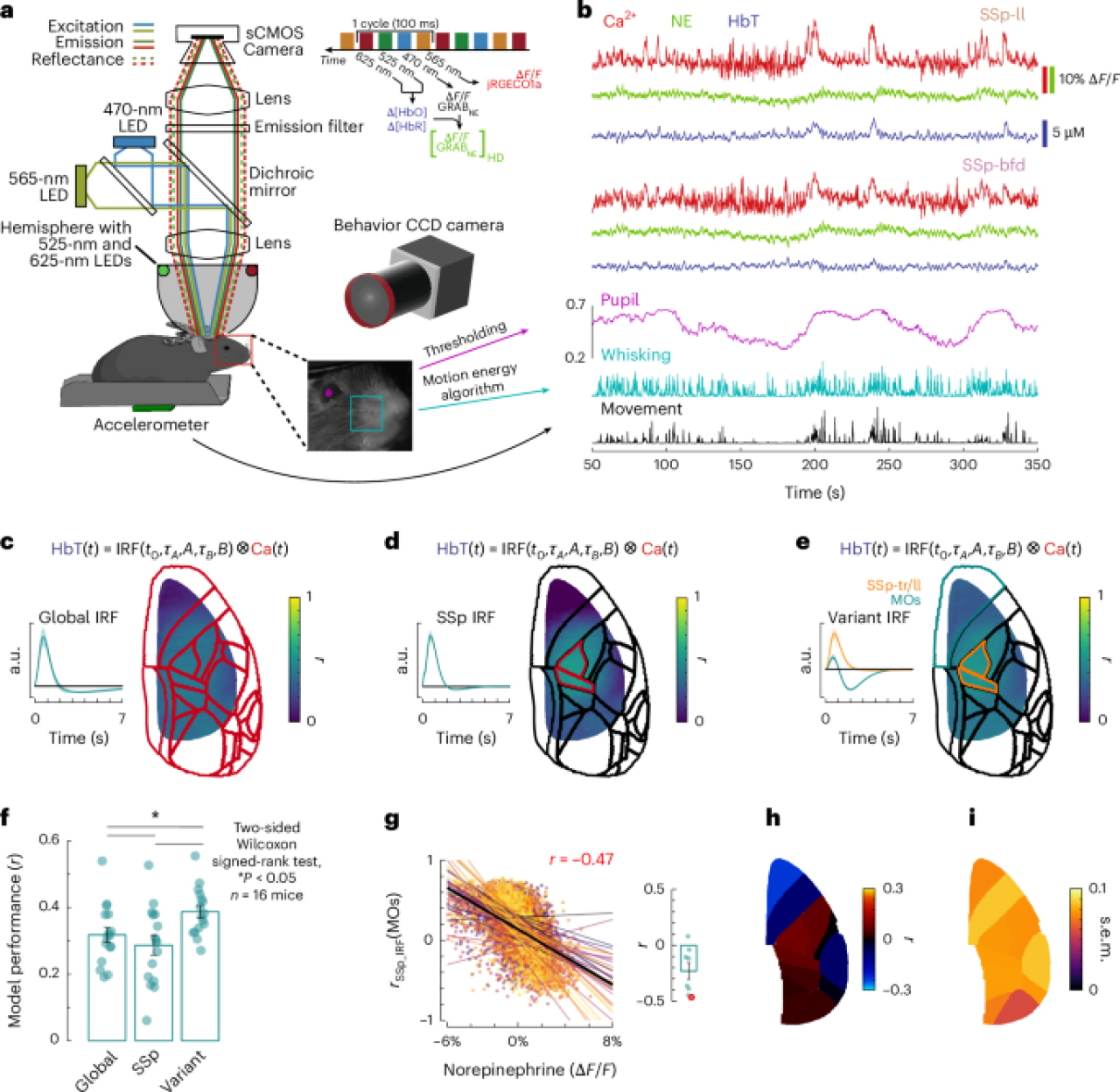
Boston University researchers report in Nature Neuroscience (26 March 2026) that the neurovascular impulse response function (IRF) linking spontaneous neuronal activity to local blood volume differs across cortical regions and tracks intrinsic neuromodulatory signals. The paper, led by Bradley C. Rauscher and Natalie Fomin-Thunemann with corresponding author Anna Devor, combines mesoscopic calcium imaging, fluorescent neuromodulator sensors and hemodynamic (HbT) measures in awake mice.
The team recorded simultaneous widefield Ca2+ signals, GRABNE (norepinephrine) and GRABACh (acetylcholine) fluorescence, and HbT across the dorsal cortex. In their dataset (n = 8 mice, n = 123 imaging sessions reported in key comparisons), the estimated IRF shapes varied by region and by the dominant neuromodulator signal. Models that accounted for region-specific neuromodulatory timing fit HbT dynamics better than a single global IRF.
Removing the region-specific NE component from HbT increased the similarity between calcium-based and hemodynamic functional connectivity measures, the authors show. That result suggests a measurable neuromodulatory contribution to spontaneous hemodynamic fluctuations, which can confound or reshape interpretations of resting-state hemodynamic connectivity if not accounted for.
The paper tests multiple IRF parameterizations (including global and region-specific variants and linear-regression approaches) and presents maps of prediction accuracy across individual mice. The authors link their findings to vasoactive properties of neuromodulators and discuss consequences for interpreting noninvasive hemodynamic signals such as fMRI.
Data and code
All data are available on DANDI at https://doi.org/10.48324/dandi.001543/0.260130.1715. MATLAB analysis code and NWB-loading scripts are on GitHub at https://github.com/NIL-NeuroScience/Neuromodulation.
Photo credit: media.springernature.com
Tags: neurovascular coupling, neuromodulation, widefield calcium imaging, GRABNE sensor, functional connectivity
Topics: Neuromodulation, Neuroscience & neuroplasticity