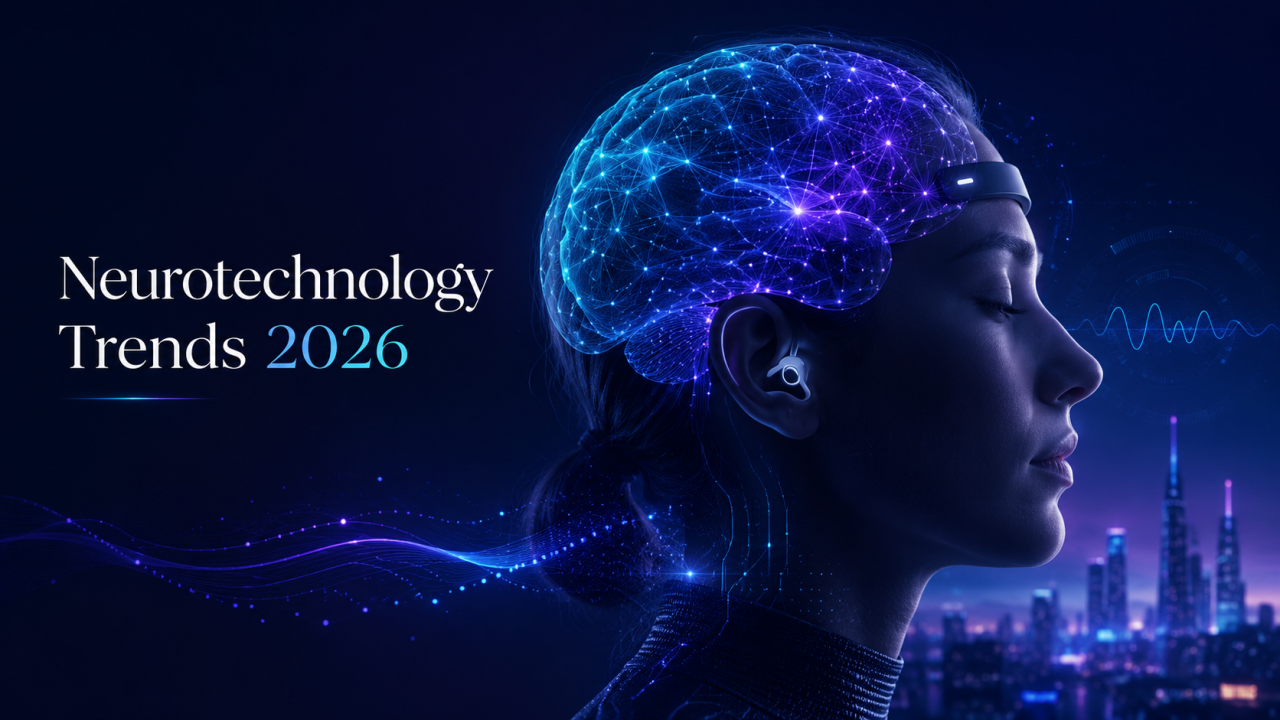
Introduction: 2026 is the year neurotechnology is moving from spectacle to infrastructure
For years, the neurotechnology industry was framed as a futuristic field: brain chips, thought-controlled computers, memory implants, mind-reading headsets and science-fiction promises about merging humans with machines. In 2026, the story is different. The most important neurotechnology trends are no longer just about dramatic demonstrations. They are about medical approvals, home-based care, regulated devices, neural data rights, AI-guided therapy and the first signs of real-world clinical infrastructure.
The biggest shift in 2026 is that neurotechnology is becoming practical. China approved a brain-computer interface medical device for commercial use to help restore hand-grasping ability in people with quadriplegia caused by cervical spinal cord injury. In the United States, at-home neuromodulation for major depressive disorder gained FDA Premarket Approval, while in-ear EEG received FDA 510(k) clearance as a new form factor for brain monitoring outside traditional clinical settings. (Reuters)
This does not mean that consumer brain chips are about to become mainstream. The real 2026 trend is more grounded: neurotechnology is becoming a medical, regulatory and data infrastructure layer. It is moving into rehabilitation, depression treatment, Alzheimer’s care, stroke recovery, traumatic brain injury, vision restoration and neurological monitoring. At the same time, governments and regulators are starting to treat neural data as a special category of sensitive information. (priv.gc.ca)
Core thesis: In 2026, neurotechnology is not becoming “mind reading for everyone.” It is becoming a serious clinical and data industry built around brain-computer interfaces, neuromodulation, AI interpretation, wearable sensing and privacy-by-design.
Executive summary: the main neurotechnology trends in 2026
| 2026 trend | What is changing | Why it matters |
|---|---|---|
| Brain-computer interfaces move toward medical commercialization | China approved a BCI medical device for commercial use in hand-function restoration | BCI is shifting from lab demonstration to regulated medical product |
| At-home neuromodulation gains credibility | ProlivRx received FDA PMA approval for at-home adjunctive treatment of major depressive disorder | Brain stimulation is moving beyond clinic-only care |
| Wearable EEG becomes more realistic | Naox Link became the first FDA-cleared in-ear EEG device | Brain monitoring is moving toward real-world, longer-duration use |
| AI becomes the decoding layer of neurotech | AI-guided systems are being used for memory-state detection and personalized stimulation | The value of neurotech increasingly depends on software and signal interpretation |
| Closed-loop systems expand beyond movement disorders | New systems target memory loss, stroke rehabilitation and adaptive stimulation | Neurotech is evolving from “recording the brain” to “reading and responding” |
| Neural data privacy becomes a strategic issue | Canada explicitly included neural data among sensitive information; Europe is debating neurotech under AI and rights frameworks | Trust and compliance are becoming core product requirements |
| Investment moves toward clinical pathways | Science, Cognito and other neurotech companies raised large 2026 rounds tied to specific clinical programs | Investors are backing medically grounded use cases, not only futuristic narratives |

1. Brain-computer interfaces are becoming real medical products
The most visible neurotechnology trend in 2026 is the maturation of brain-computer interfaces, or BCIs. For a general audience, a BCI is a system that allows the brain to communicate with an external device. That device might be a computer, a robotic glove, a prosthesis, a speech system or a therapeutic stimulator.
In March 2026, China’s drug regulator approved a BCI system designed to restore hand-movement ability, describing it as the world’s first approval of a BCI device for commercial use. The device, made by Borui Kang Medical Technology, is designed for patients with quadriplegia caused by cervical spinal cord injuries and helps them regain hand-grasping ability through a glove. Reuters reported that the product uses minimally invasive extradural implantation and wireless technology. (Reuters)
This matters because it changes the public meaning of BCI. The popular image of brain-computer interfaces is often a healthy person controlling a laptop with thoughts. But the first serious market is not entertainment or productivity. It is medical restoration: helping people regain movement, communication, vision or independence after neurological injury.
The 2026 BCI trend is also geopolitical. Reuters reported that China has elevated BCIs to a core future strategic industry and is expanding clinical trials to compete with U.S. startups. NeuCyber Neurotech, a state-backed Chinese BCI company, said it had completed seven human implantations with an earlier semi-invasive system and hoped to expand clinical trials to 50 patients in 2026. (Reuters)
What this means for the industry
The BCI race is no longer only a startup race. It is becoming a race between regulatory systems, clinical trial networks, surgical infrastructure, hardware manufacturing and national technology strategies.
In practical terms, successful BCI companies in 2026 need more than a high-resolution electrode array. They need:
- A clear medical indication
- A safe surgical or non-surgical delivery model
- Clinical evidence
- Regulatory strategy
- Reimbursement logic
- Long-term patient support
- Cybersecurity and neural data governance
- A manufacturing path that can scale beyond research prototypes
The industry is learning that a brain interface is not a single product. It is a system: device, surgery, software, training, clinical supervision, data pipeline and support workflow.
2. The market is shifting from “brain chips” to functional restoration
The BCI category is often discussed as if all brain implants are trying to solve the same problem. In 2026, that is clearly not true. The industry is splitting into use-case-specific segments: motor function, communication, memory, vision, stroke rehabilitation and sensory restoration.
Science Corporation provides one of the clearest examples. In March 2026, the company announced a $230 million Series C financing round to fund commercialization of PRIMA, its BCI retinal implant, and to expand clinical trials. Science said the capital would support commercialization of the PRIMA retinal implant and the advancement of other neural interface programs. (Science Corporation)
This is important because it expands the definition of BCI. A brain-computer interface does not have to be a device for typing with thoughts. In the case of PRIMA, BCI is linked to vision restoration. In other cases, BCI may be linked to hand movement, communication, memory support or rehabilitation.
The 2026 trend is therefore not “one brain chip to rule them all.” It is the emergence of multiple neurotechnology markets, each with its own clinical pathway.
| BCI segment | 2026 direction | Likely user group |
|---|---|---|
| Motor restoration | Brain signals controlling gloves, cursors or rehabilitation systems | Spinal cord injury, paralysis, stroke |
| Vision restoration | Retinal or visual prosthesis systems | Severe vision loss |
| Communication | Cursor, speech or text control | Locked-in syndrome, ALS, paralysis |
| Memory support | Closed-loop brain stimulation | Traumatic brain injury and memory disorders |
| Rehabilitation | Bidirectional BCI plus stimulation | Stroke and motor impairment |
This segmentation is healthy for the industry. It forces companies to stop selling “the future of the brain” and start proving value for specific patients.
3. At-home neuromodulation becomes a major 2026 trend
Neuromodulation means changing nervous system activity through electrical, magnetic, sensory or other forms of stimulation. In 2026, one of the strongest trends is the movement of neuromodulation from specialized clinics into supervised home use.
In January 2026, Neurolief announced FDA Premarket Approval for ProlivRx as the first prescription, physician-directed, at-home brain neuromodulation therapy used as an adjunctive treatment for adults with major depressive disorder who did not achieve satisfactory improvement from at least one previous antidepressant medication. The approval was supported by clinical evidence from the MOOD Study, a randomized, controlled, multicenter trial. (PR Newswire)
For the general public, this is a major shift. Brain stimulation used to sound like something that happens only in hospitals or specialized psychiatric clinics. In 2026, the model is becoming more distributed: a clinician prescribes and supervises therapy, while the patient can receive treatment at home.
That does not make neuromodulation a casual wellness gadget. The 2026 direction is not “buy a brain stimulator online and treat yourself.” It is prescription-based, physician-directed, evidence-backed care that uses the home as the delivery environment.
Why home-based neuromodulation matters
Home-based neurotechnology can change care in several ways:
- Access: patients do not need to travel repeatedly to specialized clinics.
- Adherence: therapy can become part of a routine rather than a rare appointment.
- Scalability: health systems can support more patients without requiring every session to happen in a facility.
- Data: devices can collect usage and response data over time.
- Personalization: therapy protocols can potentially adapt to patient response.
The economic logic is also strong. Clinic-based interventions are expensive to deliver at scale. If home-based neuromodulation can maintain safety and clinical effectiveness under medical supervision, it could become one of the most important neurotechnology business models of the decade.
4. Wearable EEG is moving brain monitoring into real life
Electroencephalography, or EEG, measures electrical activity in the brain. Traditional EEG usually involves scalp electrodes, clinical equipment and time-limited sessions. In 2026, wearable EEG is moving toward more compact, real-world form factors.
In January 2026, MedCity News reported that French startup Naox Technologies became the first company to receive FDA 510(k) clearance for an in-ear EEG device. Naox Link is designed to capture brain activity in everyday settings, which could help neurological care in areas such as epilepsy, Alzheimer’s disease and sleep disorders. (MedCity News)
This is a big deal because many neurological events are intermittent. A short clinical EEG session can miss what happens during sleep, stress, exercise, medication changes or daily life. A comfortable in-ear device could make longer-duration monitoring easier and more natural.
The most important word here is not “earbud.” It is context. Brain data becomes more useful when it is captured in the context of real life.
Why real-world brain monitoring matters
Traditional clinical tests often capture a snapshot. But the brain changes constantly. Sleep quality, medication, stress, fatigue, seizures, cognitive load and daily rhythms all matter. If neurotechnology can collect higher-quality signals outside the clinic, it may help clinicians see patterns that are invisible in short appointments.
That said, wearable EEG also increases privacy risk. A device that measures brain activity in daily life creates sensitive data. It may reveal sleep patterns, attention, fatigue, neurological events or emotional states. This is why wearable EEG is not only a hardware trend. It is also a data governance trend.
5. AI is becoming the operating system of neurotechnology
AI is not just a marketing layer in 2026 neurotechnology. It is becoming the core analytical layer. The brain produces complex, noisy, high-dimensional signals. Without advanced software, much of that data is difficult to interpret. AI helps classify signal patterns, detect states, personalize stimulation and support closed-loop systems.
Nia Therapeutics is a strong example. In March 2026, the company announced FDA Breakthrough Device Designation for its Smart Neurostimulation System, an AI-guided brain implant for episodic memory loss in adults with prior moderate-to-severe traumatic brain injury and persistent memory deficits. The company said the implant decodes memory states from neural activity on 60 channels across four brain regions and delivers AI-guided personalized stimulation. (Business Wire)
This is the essence of the new neurotechnology stack:
Sense → decode → decide → stimulate → measure response.
That loop is very different from older stimulation models. Instead of delivering the same stimulation pattern on a fixed schedule, a closed-loop system listens to the nervous system, interprets what is happening and responds at the right moment.
Why AI matters in neurotechnology
AI can support neurotech in several ways:
- Signal cleaning: removing noise from brain or nerve recordings
- State detection: identifying sleep stages, seizure risk, attention, fatigue or memory encoding states
- Personalization: adapting therapy to an individual’s neural patterns
- Prediction: detecting early signs of neurological change
- Closed-loop control: triggering stimulation only when needed
- Clinical decision support: helping clinicians interpret long-duration brain data
But AI also raises the stakes. If an algorithm influences stimulation, diagnosis or therapy recommendations, it becomes part of the medical risk profile. In 2026, neurotechnology companies must prove not only that their hardware works, but that their AI models are safe, explainable enough for clinical use and robust across patients.
6. Closed-loop neurotechnology is expanding beyond classic use cases
Closed-loop neurotechnology is one of the defining trends of 2026. A closed-loop system records signals, interprets them and responds automatically or semi-automatically. The goal is to make therapy more adaptive and precise.
In April 2026, CorTec announced that the FDA granted Breakthrough Device Designation for its Brain Interchange system in stroke rehabilitation. The designation covers direct cortical electrical stimulation to support motor recovery in people with chronic stroke-related impairments. CorTec also stated that the system was accepted into the FDA Total Product Life Cycle Advisory Program in April 2026. (cortec-neuro.com)
This is important because it moves BCI beyond communication and device control. Many brain-computer interface systems are designed to help a person control an external device. CorTec’s 2026 direction points toward therapeutic restoration: using brain signals and stimulation to support recovery.
Nia Therapeutics points in another direction: memory. Its AI-guided implant targets episodic memory loss after traumatic brain injury, using neural recordings and stimulation in a personalized closed-loop approach. (Business Wire)
The broader implication
The future of neurotechnology is not only about reading brain signals. It is about interacting with neural systems dynamically.
That interaction can take different forms:
| Closed-loop target | What the system may do |
|---|---|
| Stroke recovery | Record brain activity and stimulate cortical regions to support motor rehabilitation |
| Memory loss | Detect impaired memory states and deliver targeted stimulation |
| Epilepsy | Detect abnormal activity and intervene before or during events |
| Depression | Adjust neuromodulation based on symptoms or biomarkers |
| Sleep disorders | Track brain activity and guide therapy timing |
Closed-loop systems will likely become one of the most valuable areas of neurotechnology because they promise precision. But they will also be one of the hardest to regulate, because the therapeutic effect depends on hardware, software, algorithms, electrodes, clinical context and patient-specific response.
7. Neurotechnology funding is becoming more clinically disciplined
The 2026 investment story is not just about big numbers. It is about a change in investor logic. Investors are backing neurotechnology companies with clearer clinical pathways, defined indications and stronger commercialization narratives.
Science Corporation’s $230 million Series C is tied to commercialization of the PRIMA BCI retinal implant and expansion of clinical trials. (Science Corporation) Cognito Therapeutics announced an oversubscribed $105 million Series C financing to advance Spectris in Alzheimer’s disease, positioning the company for pivotal study data readout, FDA submission and anticipated commercialization. (Business Wire)
Cognito is especially interesting because Spectris is not an implanted brain chip. It is an investigational, physician-prescribed, at-home therapeutic platform using non-invasive visual and auditory stimulation to evoke coordinated neural activity across brain networks. (Business Wire)
This shows how broad neurotechnology has become. The category now includes invasive BCIs, non-invasive sensory stimulation, at-home neuromodulation, wearable EEG, retinal implants and AI-guided stimulation systems.
What investors appear to value in 2026
| Investor priority | Why it matters |
|---|---|
| Specific clinical indication | Makes regulatory and reimbursement pathways clearer |
| Strong evidence plan | Reduces “science project” risk |
| Home-based scalability | Expands patient access and improves commercial economics |
| AI-enabled personalization | Creates defensibility and better patient targeting |
| Regulatory milestones | Signals credibility to hospitals, payers and partners |
| Data infrastructure | Turns device usage into long-term clinical value |
The days of vague “brain enhancement” pitches are fading. The strongest 2026 neurotech companies are building around specific diseases, measurable outcomes and realistic care pathways.
8. Neural data privacy becomes a board-level issue
One of the most important neurotechnology industry trends in 2026 has nothing to do with electrodes. It is the rise of neural data privacy.
In February 2026, Canada’s Office of the Privacy Commissioner updated its interpretation bulletin on sensitive information to explicitly include neural data among categories that generally require a higher degree of protection. The bulletin lists neural data alongside health data, genetic data, biometric data and other highly sensitive categories. (priv.gc.ca)
This matters because neurotechnology devices can collect information that feels more intimate than ordinary health metrics. Heart rate tells you something about the body. Brain and nervous system data may potentially reveal attention, fatigue, stress, sleep, emotional response, cognitive state or neurological risk.
Europe is also moving toward more serious neurotechnology governance. The Centre for Future Generations argued in April 2026 that Europe needs a neurotechnology strategy because advances in BCIs, neurostimulation, AI-enhanced diagnostics and wearable devices are opening new medical possibilities while raising issues around safety, transparency, informed consent, mental privacy, autonomy and misuse. (Centre for Future Generations)
Why neural data is different
Neural data creates difficult questions:
- Who owns brain activity data?
- Can a company train AI models on it?
- Can it be used for advertising or profiling?
- Can employers access attention or fatigue metrics?
- Can insurers use neurological risk signals?
- Can users delete their brain data?
- What happens if neural data is hacked?
These questions are not theoretical anymore. As wearable EEG, BCI and neuromodulation devices move closer to real-world use, companies need privacy-by-design. In 2026, trust is becoming part of the product.
The winning neurotech companies will not be the ones that only collect the most brain data. They will be the ones that can prove why they collect it, how they protect it and how users stay in control.
9. The EU AI Act creates a new compliance environment for neurotech
Because modern neurotechnology increasingly uses AI, the EU AI Act is becoming highly relevant to the industry. The European Commission’s AI Act implementation page states that the Act is fully applicable from 2 August 2026, with specific exceptions and transition periods for certain categories, including high-risk AI systems embedded into regulated products. (Digital Strategy)
For neurotechnology, the impact is indirect but significant. Many neurotech systems use AI for neuroimaging, BCI decoding, stimulation personalization, diagnostics or cognitive-state interpretation. A 2026 UOC discussion of neurotechnologies and the AI Act emphasized that current rights and European regulatory frameworks may need to be interpreted in ways that protect freedom of thought, privacy and integrity in technological contexts. (UOC)
The industry should expect more scrutiny around:
- Transparency of AI-driven neural interpretation
- Human oversight in medical decision-making
- Safety of AI-guided stimulation
- Bias across patient groups
- Explainability for clinicians
- Data minimization
- Cybersecurity
- Post-market monitoring
For consumer neurotech, the challenge may be even harder. If a headset claims to measure focus, stress or emotional state, regulators may ask whether that claim is wellness, medical, employment-related profiling or high-risk inference.
10. Neurotechnology is becoming a national strategy issue
In 2026, neurotechnology is no longer just a private-sector market. It is becoming part of national strategy.
China’s BCI acceleration is the clearest example. Reuters reported that Beijing elevated BCIs to a core future strategic industry in its latest five-year plan, placing them alongside sectors such as quantum technology, embodied AI and nuclear fusion. (Reuters)
Europe is also reassessing its position. The Centre for Future Generations warned in April 2026 that Europe risks falling behind global competitors if neurotechnology remains trapped between fragmented funding streams and indirect regulatory frameworks. The same paper argues for a European neurotechnology strategy that supports responsible innovation while embedding ethics, rights and public interest. (Centre for Future Generations)
This geopolitical dimension matters because neurotechnology depends on more than startup talent. It requires:
- Clinical trial networks
- Neuroscience research infrastructure
- Medical device manufacturing
- Regulatory expertise
- AI talent
- Data governance frameworks
- Hospital partnerships
- Public funding
- Reimbursement pathways
The countries that coordinate these layers well will have an advantage. The countries that treat neurotechnology as a collection of isolated research projects may struggle to commercialize their scientific strengths.
11. The most realistic consumer trend is brain monitoring, not mind control
For the general public, neurotechnology is often surrounded by exaggerated narratives. The most realistic consumer-facing trend in 2026 is not direct mind control. It is brain and nervous system monitoring.
Wearable EEG, sleep-focused brain devices, cognitive wellness tools and stress-monitoring systems are all part of this direction. Naox Link’s FDA-cleared in-ear EEG form factor shows how brain monitoring may become more comfortable and less clinic-bound. (MedCity News)
However, the consumer market faces a credibility problem. Many people are interested in focus, sleep, stress and cognitive performance. But the more a device claims to interpret mental state, the more it must justify its accuracy. A consumer should ask:
- Is this medical-grade or wellness-only?
- What exactly is being measured?
- Is the device measuring brain activity directly or using proxy signals?
- Is the output clinically validated?
- Does the company explain uncertainty?
- Who can access the data?
In 2026, the consumer neurotech winners will likely be the companies that avoid overclaiming. “This device helps track sleep-related brain activity” is more credible than “this device reads your mind.”
12. The neurotechnology stack: hardware is only one layer
A major 2026 insight is that neurotechnology is not just hardware. The product stack is getting deeper.
| Layer | What it includes | Why it matters |
|---|---|---|
| Hardware | Implants, electrodes, earbuds, headsets, stimulators | Captures or influences neural activity |
| Signal processing | Filtering, artifact removal, feature extraction | Turns raw signals into usable data |
| AI models | Classification, prediction, personalization | Enables adaptive and scalable interpretation |
| Clinical workflow | Physician dashboards, prescription flow, monitoring | Makes the device usable in healthcare |
| Data governance | Consent, privacy, cybersecurity, deletion rights | Builds trust and regulatory compliance |
| Evidence layer | Trials, endpoints, publications, post-market data | Supports adoption and reimbursement |
| Commercial layer | Reimbursement, distribution, training, support | Determines whether the technology reaches patients |
Many neurotech startups historically focused on the first layer: the device. In 2026, the winners are building the full stack.
A brain implant without clinical workflow is a prototype. A wearable EEG without privacy controls is a liability. A neuromodulation device without evidence is a wellness claim. An AI model without clinician trust is a black box. The 2026 neurotechnology industry is forcing companies to become more complete.
13. What 2026 means for patients
For patients, the 2026 neurotechnology trend is cautiously positive. The industry is moving toward real medical problems: paralysis, depression, Alzheimer’s disease, traumatic brain injury, stroke, spinal cord injury and severe vision loss.
But patients should understand the difference between regulatory categories. FDA Breakthrough Device Designation is not the same as full market approval. The FDA explains that the Breakthrough Devices Program is designed to speed development, assessment and review, but breakthrough devices must still meet rigorous standards for safety and effectiveness before marketing authorization. (U.S. Food and Drug Administration)
Patient checklist for neurotechnology in 2026
Before using or evaluating a neurotechnology product, patients should ask:
- Is the device approved, cleared, investigational or wellness-only?
- What exact condition is it intended to treat or monitor?
- Who supervises its use — a physician, clinic or consumer app?
- What evidence supports the claim?
- What are the known risks and side effects?
- What data is collected?
- Can the user delete or export data?
- Is the device covered by insurance or paid out of pocket?
- What happens if the device fails or produces unclear results?
This is not meant to discourage patients. It is meant to help them separate real medical innovation from hype.
14. What 2026 means for founders and investors
For founders, 2026 sends a clear message: neurotechnology companies must be medically serious, regulatorily literate and data-responsible.
The strongest startup opportunities are not generic “brain optimization” products. They are specific platforms that solve painful clinical problems, generate defensible data and fit into healthcare workflows.
Promising 2026 opportunity areas include:
- At-home physician-directed neuromodulation
- Wearable EEG for neurological monitoring
- AI-guided closed-loop stimulation
- BCI-enabled rehabilitation
- Retinal and sensory neuroprosthetics
- Neurodegenerative disease monitoring
- Stroke recovery systems
- Neural data privacy infrastructure
- Clinical trial tools for brain disorders
For investors, the key question is no longer “Is this futuristic?” The better question is: Can this become a reimbursed, trusted, clinically validated product?
15. The biggest risks in the 2026 neurotechnology industry
The industry has enormous potential, but the risks are real.
Risk 1: hype outruns evidence
Neurotechnology attracts attention because the brain is emotionally powerful. Companies can easily overstate what their devices can do. In 2026, credible companies must communicate limitations clearly.
Risk 2: neural data is misused
Neural data can become attractive to employers, insurers, advertisers or platforms. The inclusion of neural data in Canada’s sensitive information framework shows that regulators are starting to take this seriously. (priv.gc.ca)
Risk 3: AI systems become black boxes
If an AI model decides when to stimulate the brain or how to classify cognitive state, clinicians and regulators need to understand how safe and reliable that decision is.
Risk 4: access becomes unequal
Advanced neurotechnology could become available only to wealthy patients or elite health systems unless reimbursement and public health pathways are built.
Risk 5: consumer products blur medical boundaries
A device that claims to improve focus or reduce stress may look like wellness, but if it measures or influences brain activity, it enters a more sensitive territory.
Conclusion: the neurotechnology industry in 2026 is becoming serious
The main neurotechnology industry trend in 2026 is not that the world is suddenly becoming cybernetic. It is that brain technology is becoming serious infrastructure.
BCI is moving toward regulated medical use. At-home neuromodulation is becoming a credible care model. Wearable EEG is making real-world brain monitoring more practical. AI is becoming the decoding and personalization layer. Closed-loop systems are expanding into memory, stroke and rehabilitation. Neural data privacy is becoming a legal and ethical requirement. Governments are starting to treat neurotechnology as a strategic industry.
The most important phrase for 2026 is not “mind reading.” It is responsible clinical translation.
The companies that win will not be the ones with the loudest promises. They will be the ones that can prove safety, generate evidence, protect neural data, integrate into healthcare and solve real human problems.
References
- Reuters — China approves market launch of brain-computer interface medical device in world first.
- Office of the Privacy Commissioner of Canada — Sensitive Information Interpretation Bulletin including neural data.
- Reuters — Beijing-backed brain chip firm says it is three years behind Neuralink.
- Science Corporation — $230 million Series C for PRIMA BCI retinal implant.
- Neurolief / PR Newswire — FDA PMA approval for ProlivRx at-home brain neuromodulation therapy.
- MedCity News — FDA clearance for first in-ear EEG device by Naox Technologies.
- Nia Therapeutics / Business Wire — FDA Breakthrough Device Designation for AI-guided brain implant to treat memory loss.
- CorTec — FDA Breakthrough Device Designation and TAP acceptance for Brain Interchange in stroke rehabilitation.
- Cognito Therapeutics / Business Wire — $105 million Series C to advance Spectris in Alzheimer’s disease.
- Centre for Future Generations — Towards an EU Neurotechnology Strategy.
- European Commission — AI Act application timeline and 2026 implementation context.
- UOC — The EU AI Act could indirectly regulate emerging neurotechnologies.
- FDA — Breakthrough Devices Program.