Researchers report a noninvasive visual brain–computer interface that achieved an average online information transfer rate (ITR) of 472.72 ± 15.06 bits per minute and a single-participant peak of 551.42 bpm. The paper was published in Cyborg and Bionic Systems on Mar. 26, 2026 (DOI: 10.34133/cbsystems.0555).
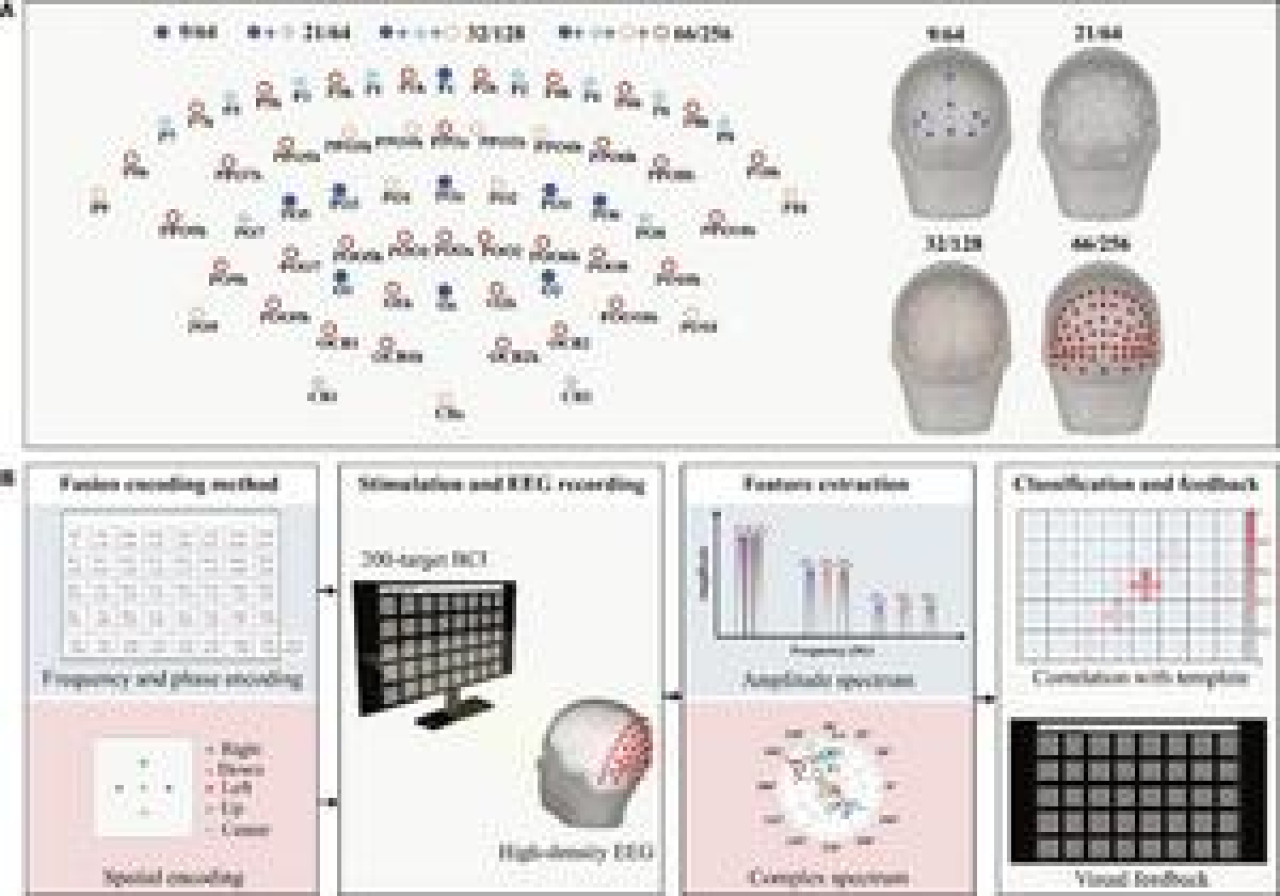
The team combined a hybrid frequency–phase–space encoding scheme with high-density EEG decoding. The encoding used 40 small flickering stimuli (8–15.8 Hz) with distinct initial phases and five embedded fixation positions to expand the command set from 40 to 200 targets without increasing interface size. For sensing, they recorded with a 256-channel cap and selected 66 parieto-occipital electrodes (mean interelectrode distance ~1.5 cm) for decoding.
Fifteen healthy volunteers took part in offline experiments; 10 completed online tests. Offline, the system reached a peak actual ITR of 470.64 ± 8.97 bpm on an 80-target task with 92.59% accuracy using 0.2 seconds of stimulus data. Online, after per-user parameter tuning, the reported average actual ITR was 472.72 ± 15.06 bpm and the highest individual result was 551.42 bpm. A dynamic window classifier that adapted stimulus duration by confidence increased peak ITR to 507.59 bpm on the 80-target task.
The authors quantified the benefit of electrode density. Using the 66/256 parieto-occipital configuration improved theoretical ITR by 83.66% over a 9/64 baseline for a 40-target frequency–phase paradigm and by 195.56% for the 200-target hybrid paradigm. They found spatial-position decoding required higher electrode density than frequency–phase decoding: at 0.5 s the 66/256 setup improved spatial accuracy by 15.53% versus a 1.32% gain for frequency decoding. Electrode-optimization analysis indicated diminishing returns: 52 electrodes sufficed for peak performance on an 80-target task, while 60 were optimal for 200 targets.
The paper lists authors Gege Ming, Weihua Pei, Sen Tian, Xiaogang Chen, Xiaorong Gao and Yijun Wang and acknowledges funding from the National Natural Science Foundation of China and national R&D programs. The team notes limitations include testing in more naturalistic conditions, broader participant populations, and the need for more user-friendly high-density EEG hardware.
"Our work demonstrates that integrating spatial information into BCI encoding, paired with high-density EEG decoding, can unlock unprecedented communication speeds for noninvasive BCIs," the authors wrote.
Photo credit: mediasvc.eurekalert.org
Tags: SSVEP, high-density EEG, visual BCI, information transfer rate, hybrid encoding
Topics: Brain–computer interfaces, EEG & neuro-sensing headsets, Wearable neurotech