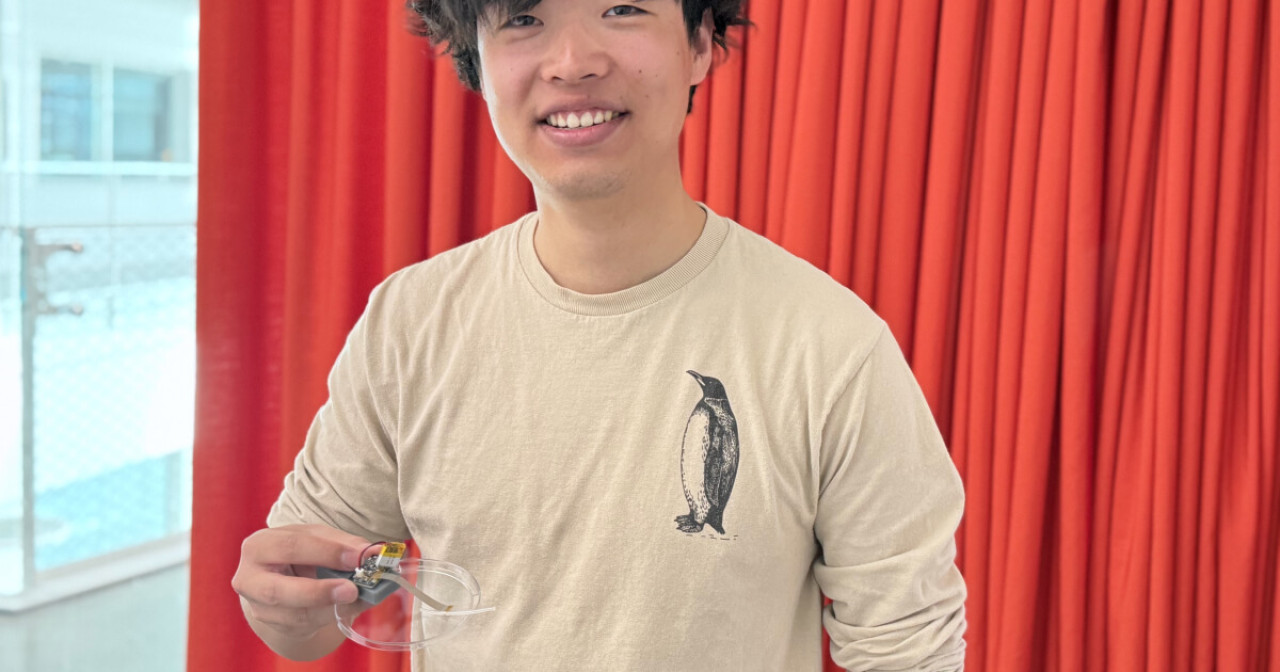
Jerry Li, a senior at Harvard SEAS, built a microfabricated ultrasonic cuff intended to steer ultrasound beams for selective stimulation of the vagus nerve, he said. Li presented the device as his capstone (ES 100) project and described it as a less invasive alternative to electrical stimulation that could be relevant to depression, epilepsy and neuroprosthetic control.
Li listed Hugh Herr, Evelyn Hu, Guillermo Herrera-Arcos and Jason Hou as advisors. He said the cuff uses PMUTs — piezoelectric micromachined ultrasonic transducers — arranged to beam-steer and target peripheral nerve fibers without direct electrical contact. PMUTs are tiny ultrasonic transducers made with microfabrication techniques.
Li said he began microfabrication in May 2025 and worked on the device over the summer. During the academic year he focused on electronics, including phased-array control and a wireless charging component for the cuff’s electronics. He described microfabrication timing as the project’s biggest challenge and listed mechanical prototyping and interdisciplinary learning as major parts of the work.
Li told reporters, “I built a device that uses ultrasound to stimulate nerves — it's ultra-precise and less invasive than electrical stimulation,” and added that, to his knowledge, no one has previously used microfabricated ultrasound transducers for peripheral nerve stimulation.
The write-up and interview present the project as a prototype and do not report animal or human test results. The work is framed as an engineering demonstration of device design, fabrication and control rather than as clinical evidence of safety or efficacy.
The project expands on recent interest in ultrasound neuromodulation by adapting microfabricated PMUT arrays to a peripheral-nerve cuff format, according to Li’s description.
Photo credit: seas.harvard.edu
Tags: ultrasound neuromodulation, vagus nerve, PMUT, peripheral nerve stimulation, neuroprosthetics
Topics: Neuromodulation, Vagus nerve & taVNS, Neuroprosthetics & neural implants