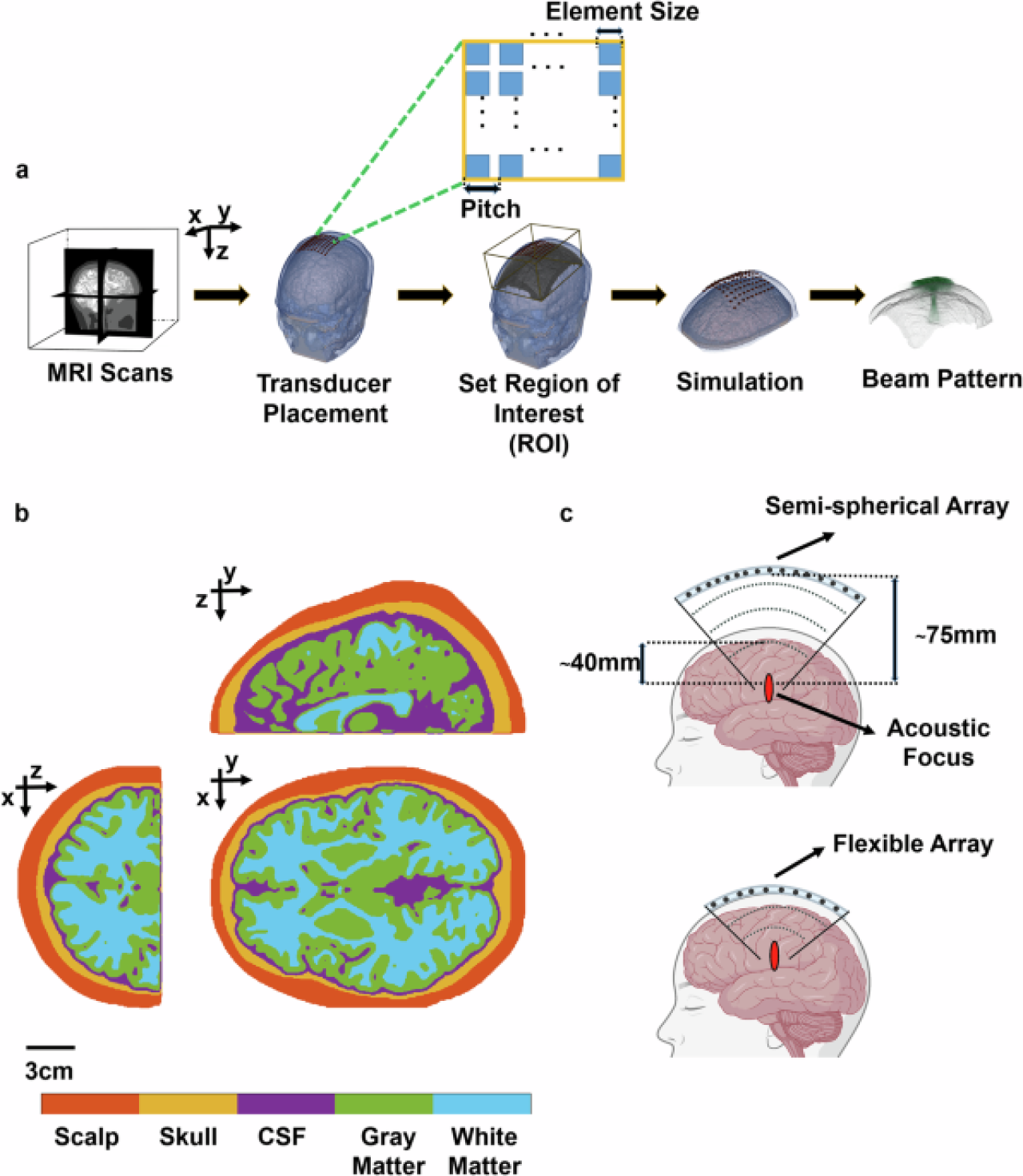
Researchers at Duke University and collaborators report that a skull‑conforming, flexible ultrasound array can produce tighter, higher‑pressure ultrasound foci than a comparable semi‑spherical array in numerical head models. The simulation study was published in npj Acoustics on 30 March 2026 and models targeting at roughly 4 cm depth — a range that reaches perithalamic and basal ganglia regions.
The team built four MRI‑derived human head models and evaluated 0.5 MHz, 10×10 element flexible arrays with varying pitch and element sizes. They compared uniform, spiral and simulated‑annealing optimized random element patterns against a semi‑spherical rigid array. Performance measures included depth full‑width at half‑maximum (FWHM), x–y focal area, peak focal pressure, transmission ratio (through skull vs. water) and peak sidelobe ratio (PSLR).
Key results: a random‑patterned flexible array delivered the tightest focus and lowest sidelobes. The random array’s z‑axis FWHM was 29.4% smaller than the semi‑spherical array and produced a 10.23 mm² focal area versus 12.9 mm² for the semi‑spherical design. PSLR for the random pattern was 0.39. Peak pressure at focus reached 0.13 MPa for the random array, compared with 0.09 MPa for the semi‑spherical array. The flexible design maintained more than 80% of peak pressure when electronically steered up to ±15 mm laterally and ±10 mm axially in tests of a 60×20 mm2 steering window.
The simulations also show design tradeoffs: increasing array pitch narrowed the mainlobe but reduced peak pressure modestly; larger element apertures raised transmission ratio (from ~0.31 to ~0.36) while slightly widening the focal depth. Element‑wise contribution varied by subject model, indicating skull geometry drives some performance variability.
The authors emphasize these findings are from numerical models and note practical challenges remain before clinical use, including fabrication, coupling to the scalp, and in‑vivo validation. The study’s code is available from the authors’ repository at gitlab.oit.duke.edu/pilab/flexible-array-simulation. The paper lists NIH and NSF funding; corresponding author Junjie Yao disclosed a financial interest in Lumius Imaging unrelated to this work.
Photo credit: media.springernature.com
Tags: transcranial focused ultrasound, wearable ultrasound, simulation study, skull-conformal array
Topics: Non-invasive brain stimulation, Neuromodulation, Wearable neurotech