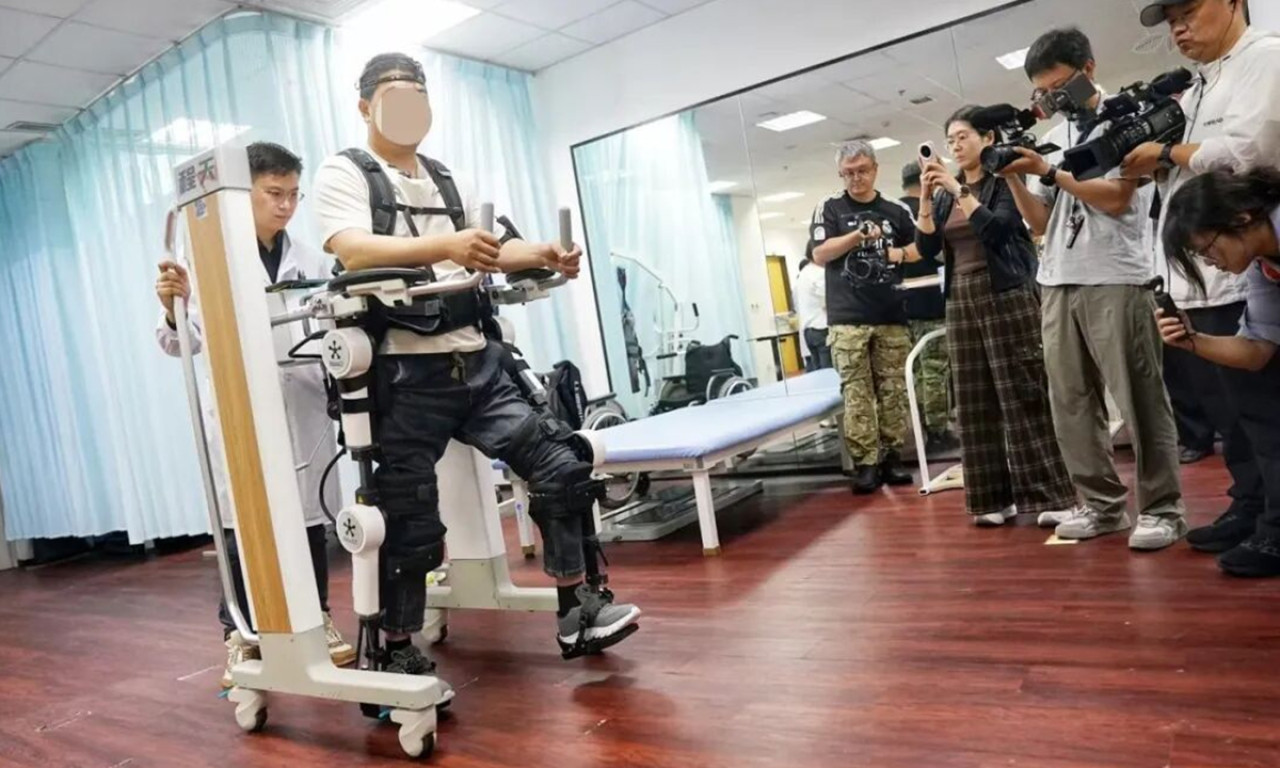
A team at Xuanwu Hospital, Capital Medical University, reported that a late-stage paraplegic patient improved from complete spinal cord injury (ASIA Grade A) to incomplete injury (ASIA Grade C) one year after receiving an invasive brain–computer interface alongside a temporally programmed spinal cord stimulation system and staged rehabilitation, state broadcaster CCTV reported.
The procedure was performed on May 16, 2025, on a patient who had sustained a severe T12–L1 injury five years earlier and had shown no meaningful response to conventional rehabilitation, the report said. The hospital credited the improvement to a combined system centered on the invasive "Beinao No.1" BCI, spinal cord stimulation timed to decoded motor intentions, and an integrated exoskeleton that provided closed‑loop gait assistance.
The team says the Beinao No.1 system decodes the patient’s motor intentions from brain signals and triggers spinal stimulation within seconds to activate damaged lower spinal circuits. The system then links stimulation output with an exoskeleton to reconstruct gait through closed‑loop control, according to the report.
Local media framed the outcome as a clinical breakthrough and said the case challenges the belief that complete spinal cord injuries necessarily cause irreversible motor and autonomic loss. The hospital and domestic research partners also described the therapy as having verified safety and "neurorestorative effectiveness" in clinical application, per Global Times and CCTV summaries.
Reporting to date describes a single patient and does not include peer‑reviewed data, broader safety statistics, or details on follow‑up assessments beyond the one‑year outcome. The team’s claims and the system’s reproducibility will depend on further published evidence and larger clinical series.
Photo credit: www.globaltimes.cn
Tags: Beinao No.1, spinal cord injury, brain-computer interface, spinal cord stimulation, exoskeleton
Topics: Brain–computer interfaces, Neuromodulation, Neuroprosthetics & neural implants