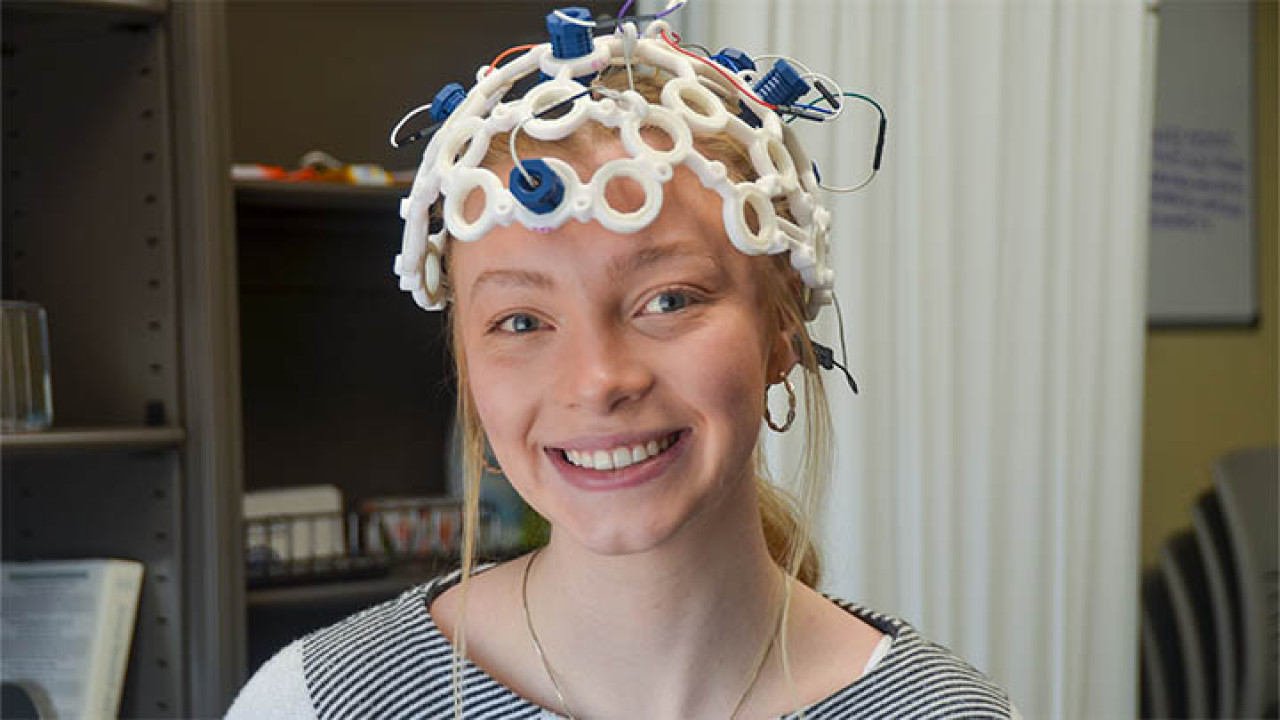
Carmella Ryan, a junior psychology major at Slippery Rock University, and instructor Shannon McKnight have prepared an EEG study that tests how emotion affects memory encoding. The pair are recruiting adults to view emotional words on a screen while an electroencephalogram records the late-positive potential (LPP), a brain response that rises when people see emotionally meaningful or attention-grabbing material.
The study focuses on emotional words tied to time and will analyze EEG responses to each word as participants perceive them. Ryan spent a semester tagging 2,200 candidate words for emotional association and reduced that list to 120 words chosen for strong, research-backed emotional content.
“I’ve always been interested in the brain, and how we can only do something when the brain is firing,” Ryan said. Her project began in a research methods class and continued into an independent capstone for her neuroscience concentration.
McKnight, who oversees the EEG component, praised Ryan’s initiative. “Carmella is dedicated to doing her own research,” McKnight said. She noted that Ryan’s focus on emotional processing complements the instructor’s expertise in EEG methods.
The researchers say results are intended to help clinicians improve assessment of mental-health diagnoses and to give neuroscientists clearer measures of emotional memory. Ryan, who also works in a psychiatric unit, said the experience has steered her toward further graduate study and a research career.
Eligible adults can register to participate using the study’s recruitment form maintained by the lab. More information about SRU’s psychology program is available on the university’s program pages.
Photo credit: news.sru.edu
Tags: EEG, late-positive potential, emotional memory, student research
Topics: EEG & neuro-sensing headsets, Neuroscience & neuroplasticity, Mental health technology