Researchers report that population activity in midbrain and pontine sleep circuits is low-dimensional and that an infraslow population component predicts transitions from NREM to REM sleep.
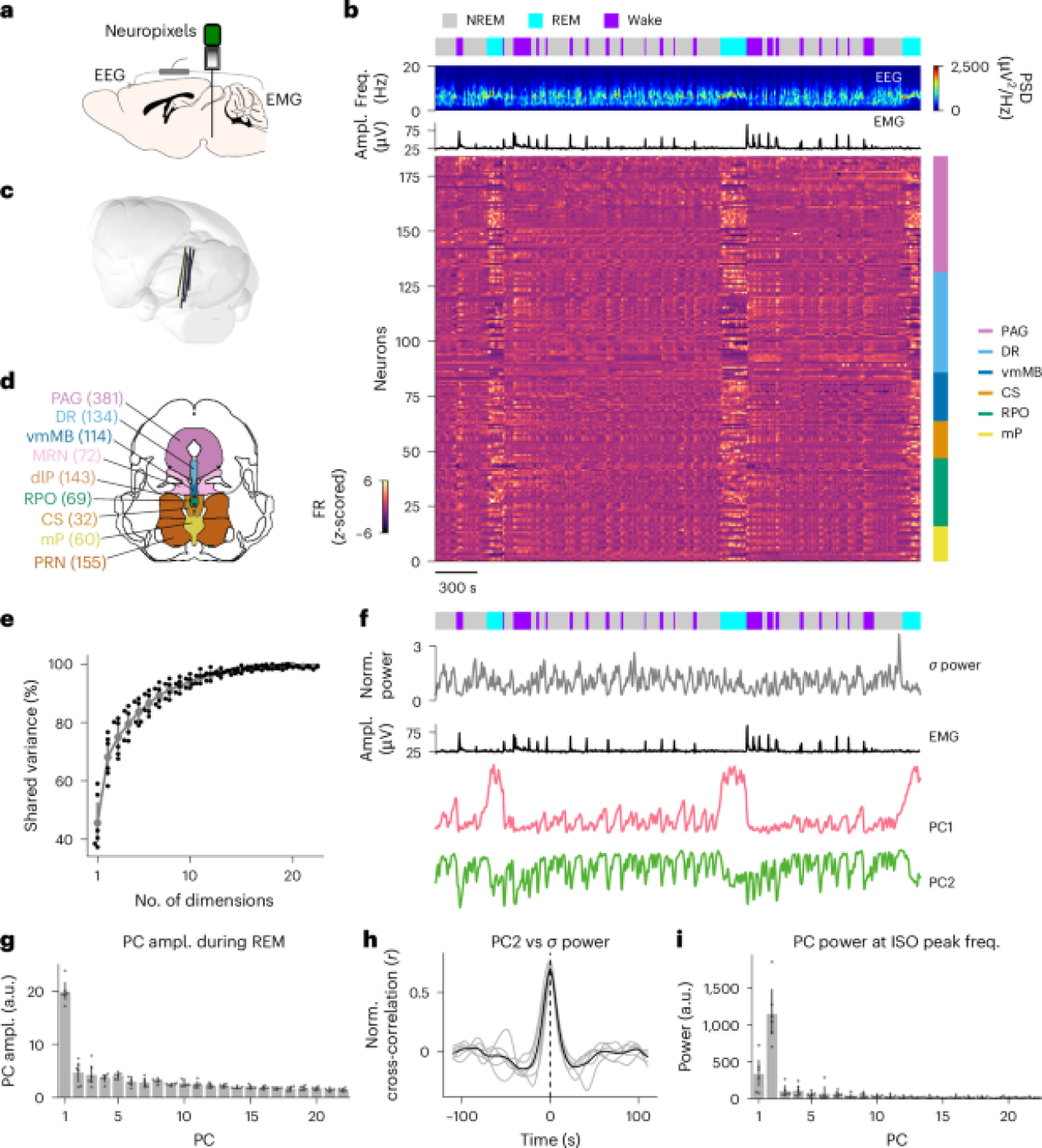
Lozano et al. published the result in Nature Neuroscience on 25 May 2026. The team recorded with Neuropixels probes in head-fixed C57BL/6J mice (n = 6), combining simultaneous EEG and EMG. Recordings lasted on average 2.56 h per animal, with 162–226 neurons sampled per mouse across periaqueductal, raphe and pontine areas.
Dimensionality reduction showed most shared variance was captured by two principal components. PC1 rose during REM. PC2 reflected infraslow (~minute) fluctuations that correlated with EEG σ-band infraslow oscillations. The authors report that PC2, by itself, allowed above-chance prediction of whether an NREM epoch would convert to REM or wakefulness starting about 110 seconds before the transition.
Neurons separated into subgroups by their correlation to PC1 and PC2. Two large, opposing classes behaved as putative REM-on and REM-off populations. REM-off neurons led REM-on neurons on the order of seconds and declined across the inter-REM interval, while REM-on neurons ramped up. These antagonistic dynamics appeared on fast state transitions, infraslow cycles, and longer ultradian (inter-REM) timescales; median inter-REM interval reported was 910 s.
Optogenetic manipulations modulate the infraslow component and REM gating
Using optogenetics, the team tested causal effects. Activation of GAD2-expressing neurons in the dorsomedial medulla (dmM) rapidly increased PC2 and altered the ability of upstream circuits to trigger REM. In contrast, excitation of identified wake-promoting medullary neurons suppressed PC2. Stimulation of mPFC→LH projections produced REM episodes whose success correlated with pre-stimulation PC2 levels.
The authors conclude that a single, low-dimensional infraslow population component organizes antagonistic subpopulations across the brainstem to gate NREM→REM transitions. Data and methods are reported in Lozano D.E. et al., Nat Neurosci, 25 May 2026.
Photo credit: media.springernature.com
Tags: REM sleep, Neuropixels, Optogenetics, Brainstem, Sleep dynamics
Topics: Neuroscience & neuroplasticity, Sleep technology, Neuromodulation