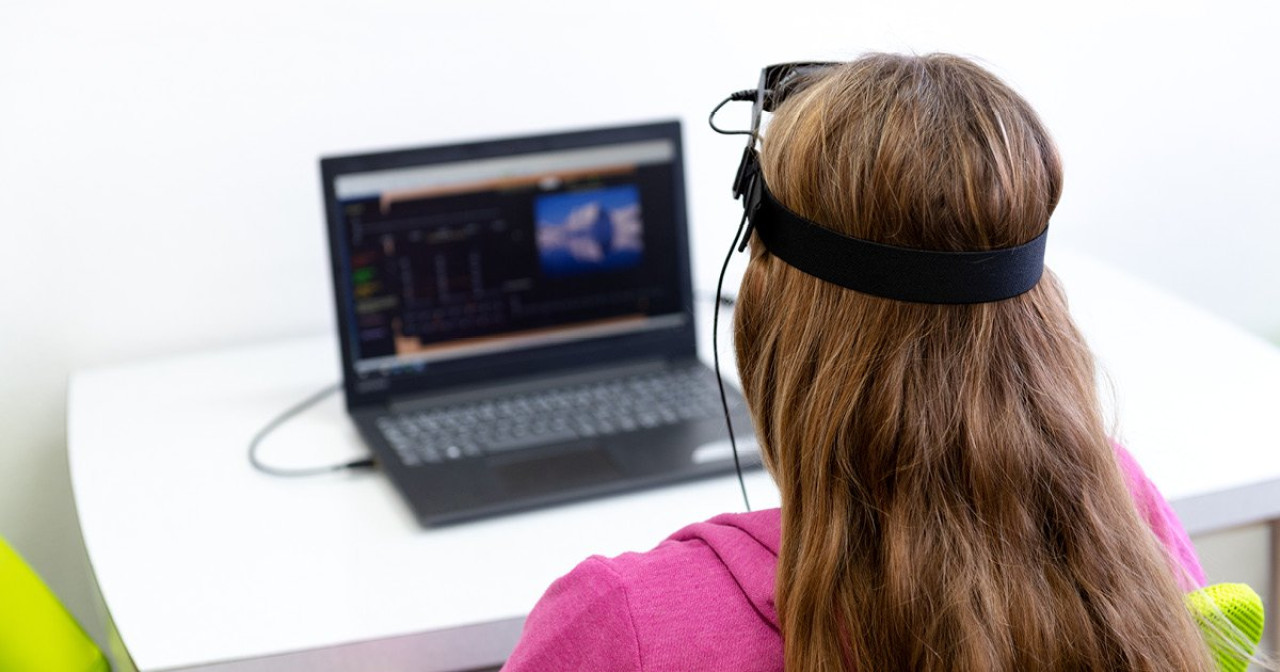
Ned Shoaei presented a poster at Cedars-Sinai’s vMed conference describing AlphaRise, a 2D brain–computer interface game that uses EEG-based neurofeedback to classify fatigue and give patients real-time visual and auditory feedback.
The game’s design draws on a survey Shoaei ran with the National MS Society of 146 people with multiple sclerosis. The group’s mean Modified Fatigue Impact Scale (MFIS) score was 52.4. Reported rates on MFIS subscales were 68.8% for physical fatigue, 62.4% for psychosocial fatigue and 56.5% for cognitive fatigue. Shoaei said only 12% of respondents found their current fatigue-coping strategies “very effective.”
Survey results shaped concrete design choices. Sessions are five minutes because 80% preferred under 10 minutes. The interface uses blue and yellow with no red or green to accommodate optic nerve sensitivity reported by respondents. A minimal UI responds to the 73% who wanted something easy to use. Shoaei told Healio that 96% of surveyed patients were willing to try games and 74% already played video games.
AlphaRise accepts EEG input and classifies brain activity into five states: focus, calm, neutral, mild fatigue and high fatigue. Those states map to changes in Pip, a circle-shaped avatar whose expression and color reflect the player’s state. The game pairs that avatar with a reactive environment, a neural-energy metric, a reward system and a path generator.
Shoaei said the system adjusts difficulty every 12 seconds to keep play achievable for people with high fatigue. If a player cannot sustain regulation, the game switches to a “Compassionate Mode” that retests continuously and returns to normal play when 30% positive states are detected, a design Shoaei described as respecting MS patients’ energy needs.
Shoaei recommended a clinical pilot trial to test AlphaRise in people with MS. The work was presented as a poster: Shoaei N. "AlphaRise: A compassionate neurofeedback game for MS fatigue management." vMed; March 25–26, 2026; Los Angeles. Healio could not confirm Shoaei’s financial disclosures at the time of publication.
Photo credit: www.healio.com
Tags: multiple sclerosis, fatigue, neurofeedback, EEG headset, brain–computer interface
Topics: Brain–computer interfaces, EEG & neuro-sensing headsets, Biofeedback & neurofeedback