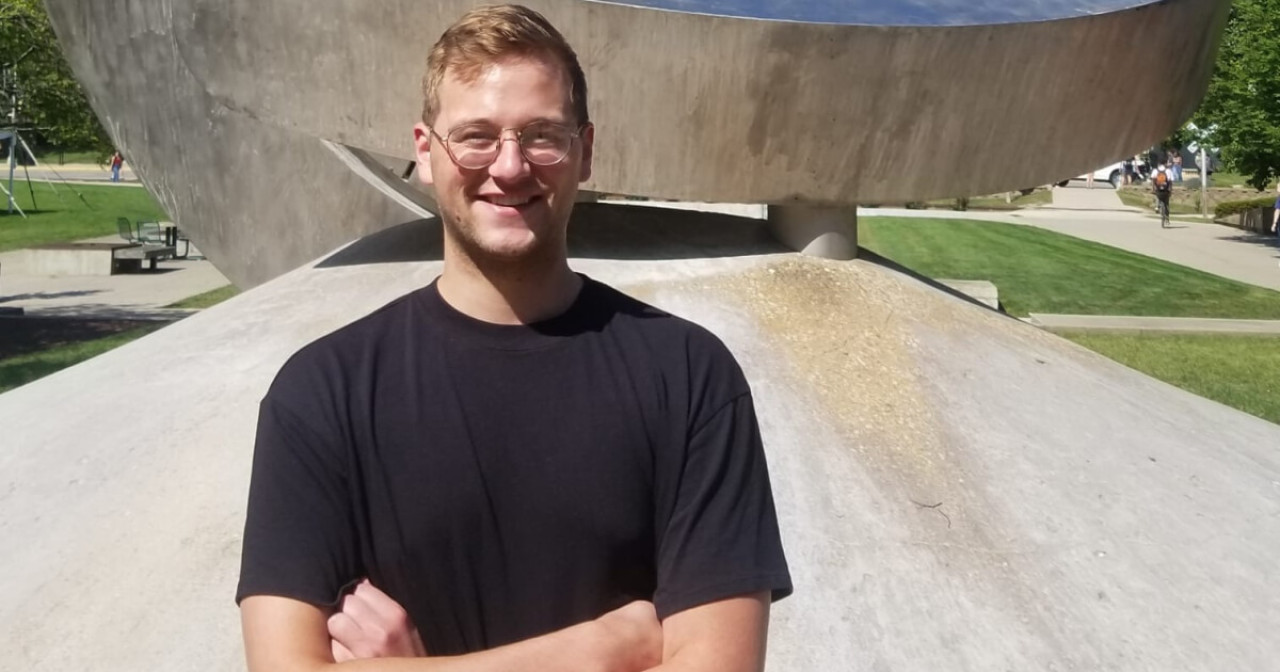
Adam Vareberg, S.B. ’19, is developing wireless devices that sit on or near the scalp to stimulate specific brain regions without the long implanted leads used in traditional deep brain stimulation (DBS). He is pursuing a Ph.D. in bioengineering at the University of Wisconsin–Madison in the Aviad Hai Lab, where the work aims to reduce invasiveness and off‑target effects linked to DBS shanks.
“You have a really long shank, and that can introduce some off‑target effects,” Vareberg said, explaining limits of conventional DBS. He said the devices his group is building are similar in size to small DBS units but omit the downward electrode shank. In the lab’s concept, a small electromagnet or other external field on the scalp would power or switch implanted modules that produce a local therapeutic field.
Vareberg joined the Hai Lab as a Ph.D. student in fall 2021 after initial work on wireless brain sensing during the early months of the COVID‑19 pandemic. He described the core trade‑off his research addresses as one between invasiveness and the spatial or temporal resolution needed to read or send signals to precise brain targets.
His path to neurotech began with a Harvard S.B. in bioengineering and summer internships at Protosthetics, a 3D‑printed orthotics and prosthetics start‑up in Fargo, North Dakota. Those experiences and a bioelectronics course at Harvard led him toward neurotechnology and the decision to pursue graduate research.
Vareberg said he plans to move into industry after finishing his Ph.D., drawn to product development and faster paths to patient impact. He framed his work in practical terms: remove surgical leads where possible, keep targeting precise, and adapt how a device acts depending on its therapeutic effect.
Photo credit: seas.harvard.edu
Tags: wireless stimulators, deep brain stimulation, wearable neurotech, neuromodulation
Topics: Non-invasive brain stimulation, Wearable neurotech, Neuromodulation