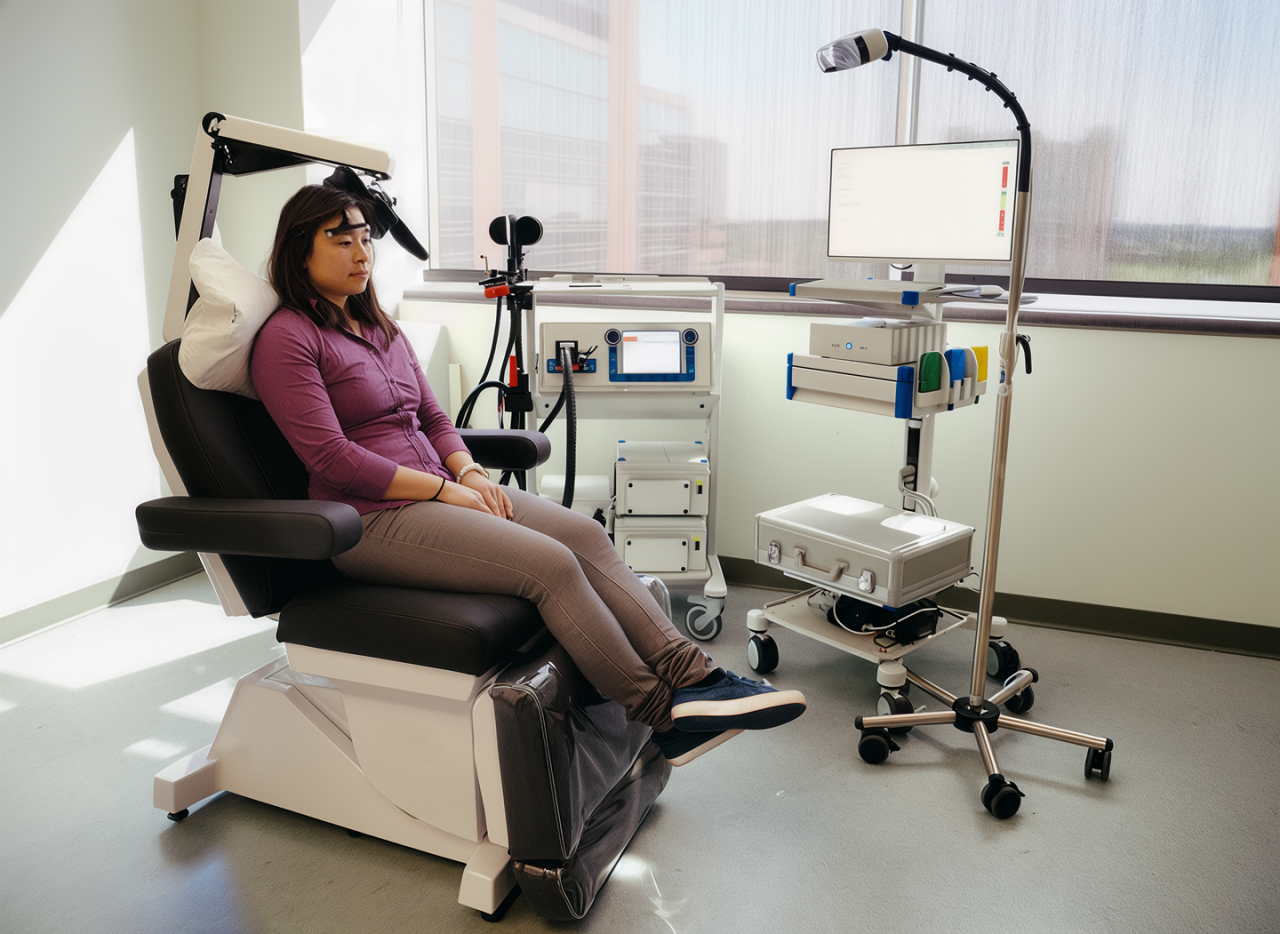
MUSC Health began offering Stanford Neuromodulation Therapy (SAINT) in 2024, becoming the first hospital system to provide the accelerated TMS protocol to patients with treatment-resistant major depressive disorder, MUSC says. The center reports remission in roughly 80% of patients by day five and an average time to remission of 2.6 days using the condensed course.
Standard repetitive transcranial magnetic stimulation (TMS) is usually given as 20-minute sessions across several weeks for a total of about 30–36 treatments. MUSC contrasts that approach with SAINT, which compresses therapy into five days with 10 short sessions per day. The hospital cites real-world TMS data showing about 62% complete remission and an 83% response rate for standard courses.
How SAINT targets the depressed brain
SAINT uses a pre-treatment functional MRI and machine-learning analysis to identify an individualized target in the dorsolateral prefrontal cortex. Clinicians then deliver repeated short magnetic pulses to that location. According to MUSC, the protocol schedules roughly 10-minute stimulation blocks each hour, with patients resting between blocks. Reported side effects are generally mild and transient, such as scalp discomfort and muscle twitching.
MUSC traces its TMS expertise to early work by Mark George, M.D., and notes that SAINT was developed at Stanford by former MUSC trainees Nolan Williams, M.D., and Brandon Bentzley, M.D., Ph.D. "We see people recover extremely quickly, thanks to SAINT," said Baron Short, M.D., medical director of MUSC Health's Brain Stimulation Service in the story.
MUSC also highlights a practical barrier: limited insurance coverage for accelerated protocols. Coverage is currently available mainly through Medicare and select insurers, the hospital says. More information and a consultation line are posted at MUSC Health Brain Stimulation and by phone at 843-792-5716.
Photo credit: d3crna64wemw02.cloudfront.net
Tags: transcranial magnetic stimulation, SAINT, major depressive disorder, fMRI targeting, MUSC Health
Topics: Non-invasive brain stimulation, Neuromodulation, Mental health technology